
Quick Answer:
For procurement, the choice is straightforward:
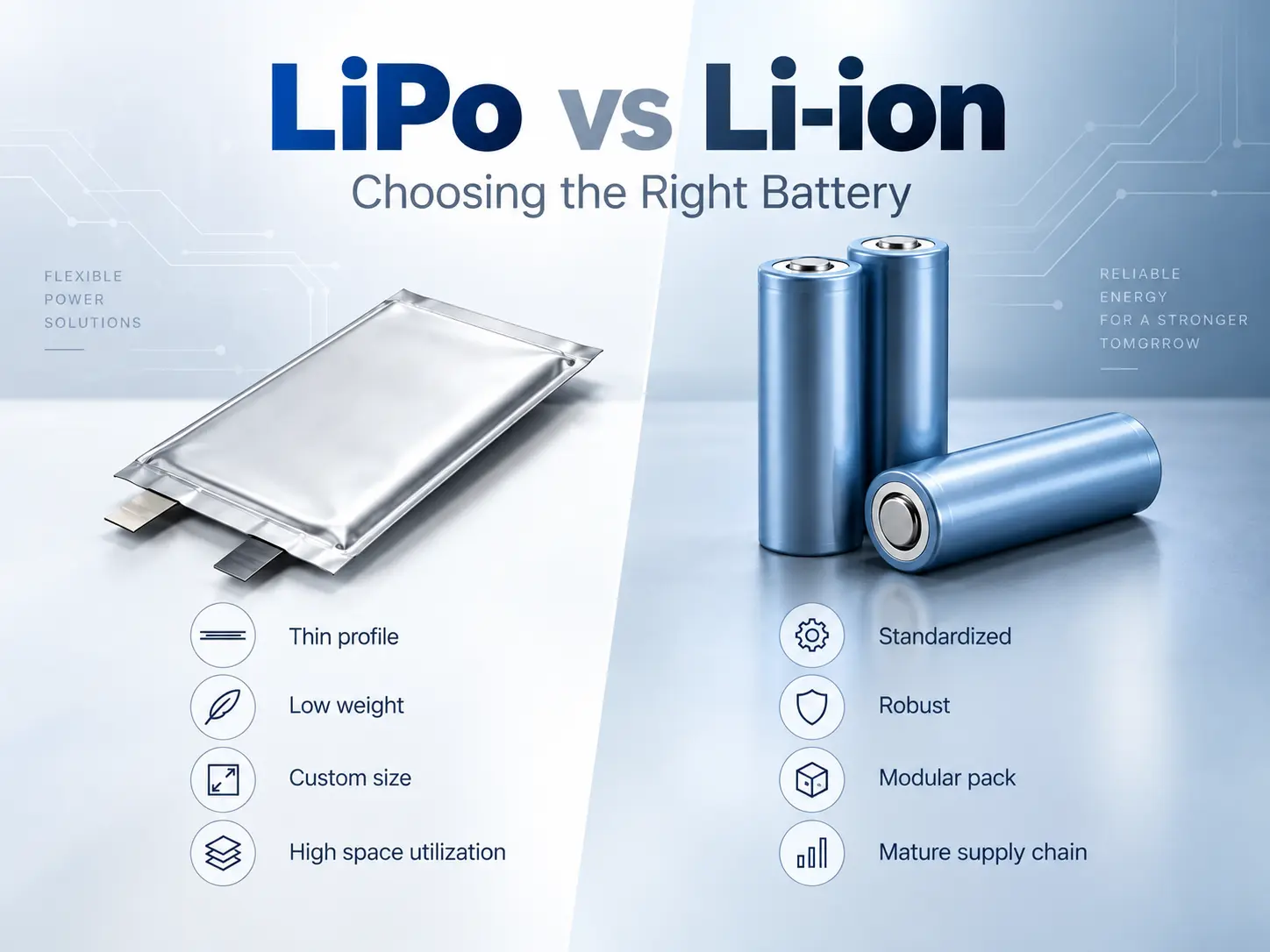
Choose a custom LiPo battery when the product requires a thin profile, low weight, custom dimensions, or high space utilization.
Choose a cylindrical Li-ion battery pack, such as an 18650 battery pack , when standardization, mechanical robustness, modular pack construction, and a mature supply chain matter more than shape flexibility.
The key point: LiPo is part of the broader lithium-ion battery family. In most commercial discussions, the real comparison is not "two completely different chemistries." It is primarily pouch-cell construction versus rigid cylindrical or prismatic cell construction.[1]
For a purchasing engineer, the decision should come down to six items:
- Available battery envelope: length, width, thickness, and weight.
- Required energy in Wh and target runtime.
- Continuous current and peak current.
- Required cycle life under defined test conditions.
- Safety, certification, and transportation requirements.
- Total system cost, not just cell price.
If those six requirements are clear, the LiPo vs Li-ion battery decision is usually clear as well.
LiPo vs Li-ion Battery: What Is the Real Difference?
Both LiPo batteries and conventional Li-ion batteries operate through lithium-ion movement between the positive and negative electrodes. Modern commercial LiPo cells are generally considered part of the lithium-ion family.[1]
The purchasing difference is mainly construction.
A cylindrical Li-ion battery, such as an 18650 or 21700, uses a rigid metal can and standardized dimensions. This supports automated manufacturing, modular pack assembly, predictable mechanical integration, and a broad supplier base.
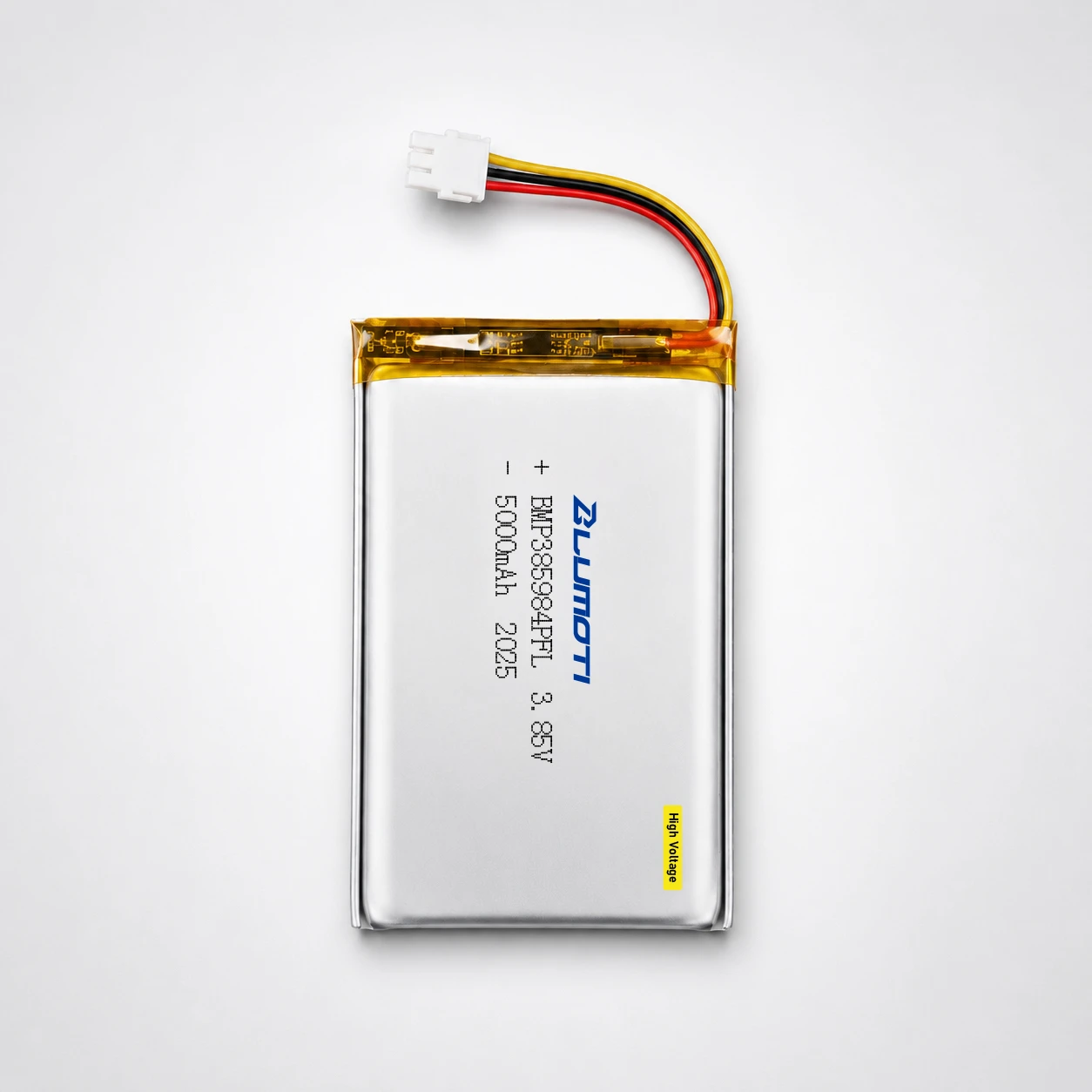
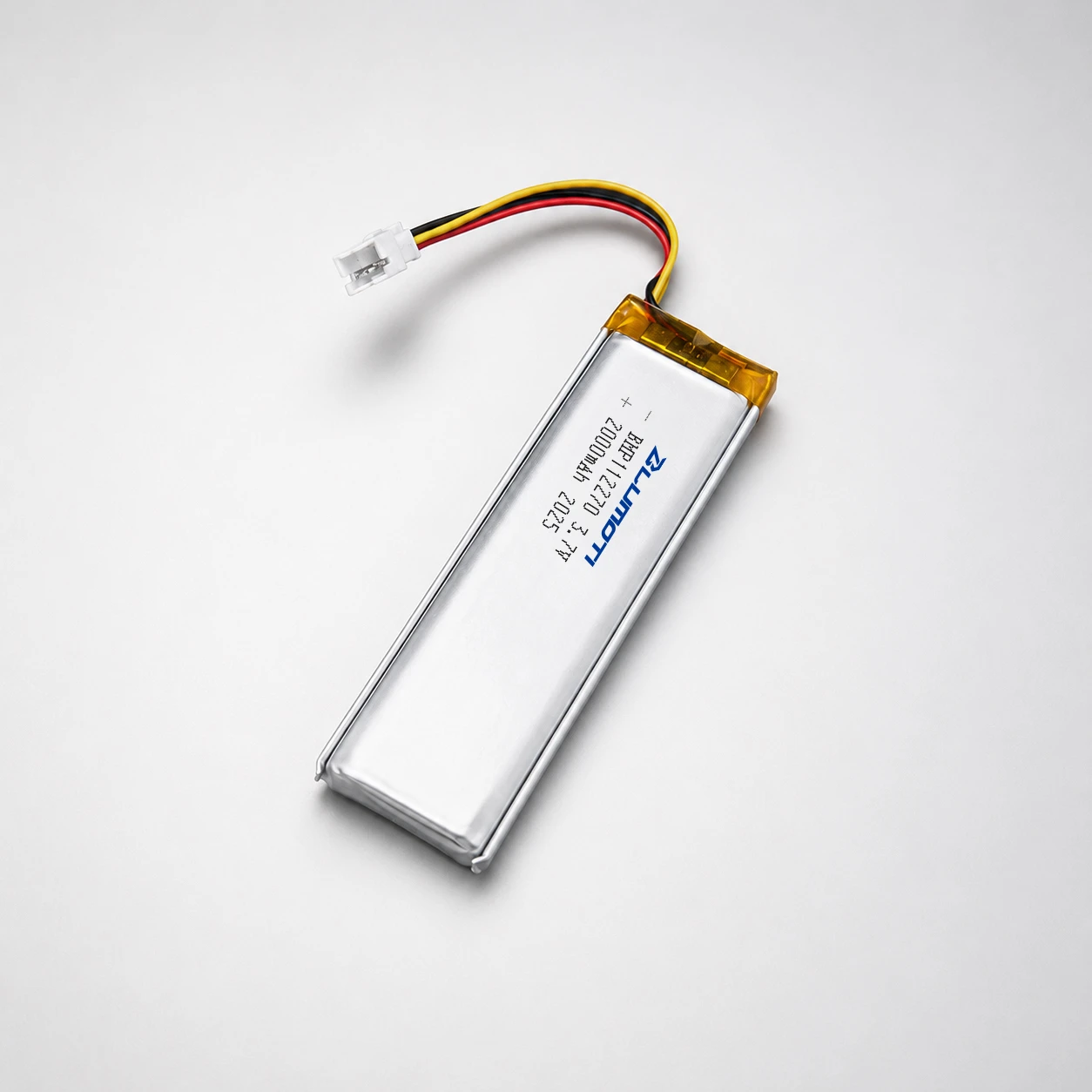
A LiPo pouch battery uses an aluminum-laminated flexible pouch. The cell can be designed around the available product space, giving engineers more freedom in length, width, and thickness.
For sourcing, this means one thing:
Do not select the battery by chemistry label alone. Select it by the actual cell specification, mechanical architecture, electrical load, lifetime target, and compliance requirement.
LiPo vs Li-ion Battery Comparison Table
|
Sourcing Factor |
Cylindrical Li-ion Battery |
LiPo Pouch Battery |
|
Battery family |
Lithium-ion |
Lithium-ion / lithium-ion polymer |
|
Typical format |
18650, 21700, other cylindrical formats |
Flexible pouch |
|
Mechanical enclosure |
Rigid metal can |
Aluminum-laminated pouch |
|
Dimension flexibility |
Low |
High |
|
Thin-device integration |
Limited |
Excellent |
|
Packaging weight |
Higher due to rigid can |
Lower in many compact designs |
|
Typical market-level specific energy |
Often around 240–270 Wh/kg for energy-oriented cells |
Often around 180–230 Wh/kg, depending on design |
|
High-current options |
Available in dedicated power cells |
Common in high-power pouch cells |
|
Typical high-power LiPo rating |
Cell-dependent |
Some products specify 20C–50C+ |
|
Cycle life |
Often several hundred to 1,000+ cycles, depending on chemistry and operating conditions |
Often several hundred cycles, highly application-dependent |
|
Mechanical protection |
Stronger at cell level |
Requires more protection from enclosure design |
|
Custom dimensions |
Limited |
Excellent |
|
Pack modularity |
Excellent |
Moderate |
|
Supply-chain standardization |
High |
Lower for fully customized cells |
|
Typical fit |
Industrial equipment, power tools, larger battery packs |
Wearables, medical devices, GPS, IoT, drones, compact electronics |
Procurement note:
The figures above are screening ranges, not guaranteed specifications. Energy density, C-rate, cycle life, maximum current, and temperature limits must be verified against the exact cell datasheet and test conditions.
1. LiPo vs Li-ion Chemistry: Ask for the Exact Cell, Not the Marketing Name
A supplier saying "this is a LiPo battery" does not tell me enough to approve the cell.
Modern LiPo batteries may use cathode systems also used in other lithium-ion cells. The term "polymer" describes aspects of electrolyte and cell construction; it does not define one universal cathode chemistry.[1]
Two cells sold as LiPo pouch batteries can therefore have very different:
- Nominal and maximum charge voltage.
- Energy density.
- Internal resistance.
- Continuous and peak discharge current.
- Cycle life.
- Temperature performance.
- Swelling behavior.
- Safety margins.
The same applies to 18650 Li-ion cells. A high-energy 18650 designed for runtime is not the same product as a high-power 18650 designed for current delivery.
For RFQ approval, ask for the exact cell model, chemistry, datasheet, charge profile, discharge limits, cycle-life test conditions, protection design, and compliance documentation.
That information is more useful than the words "LiPo" or "Li-ion" on a quotation.
2. LiPo vs Li-ion Energy Density: Compare the Finished Pack, Not Just the Cell
Generic comparisons often quote 240–270 Wh/kg for cylindrical Li-ion cells and 180–230 Wh/kg for LiPo pouch cells.
Those ranges are useful for early sourcing discussions, but they are not universal engineering limits.
Specific energy depends on cathode chemistry, electrode loading, cell architecture, power capability, safety margin, and product generation. Modern lithium-ion pouch cells can also reach very high specific energy.[2]
For procurement, compare two metrics separately:
Cell-level Wh/kg
and
Pack-level Wh/kg and Wh/L
This matters because a cylindrical battery pack also needs holders, interconnects, insulation, wiring, BMS electronics, and structural support.
A custom LiPo battery pack may use the product's available internal volume more efficiently because its dimensions can be matched to the enclosure.
Also compare energy in Wh, not mAh alone.
Battery Energy (Wh) = Nominal Voltage × Capacity (Ah)
Examples:
3.7 V × 2 Ah = 7.4 Wh
7.4 V × 2 Ah = 14.8 Wh
Two packs with the same mAh rating do not necessarily store the same energy.
3. Custom LiPo Battery Form Factor: The Main Reason to Choose Pouch Cells
The strongest procurement argument for a custom LiPo battery is usually mechanical integration.
A standard 18650 battery is approximately 18 mm in diameter and 65 mm long. The format is mature and predictable, but the enclosure must accommodate that geometry.
A custom pouch cell gives the product team more control over:
- Length.
- Width.
- Thickness.
- Capacity.
- Wire length.
- Connector type.
- Protection circuit.
- NTC configuration.
This is why custom LiPo batteries are widely used in wearable devices, medical electronics, GPS trackers, IoT sensors, handheld products, drones, RC equipment, and compact consumer electronics.
Battery University notes that pouch construction can reduce packaging weight and support thinner cell formats compared with rigid housings.[1]
From a buyer's perspective, this is the correct reason to pay for customization:
The cell solves a packaging problem that a standardized cylindrical format cannot solve efficiently.
Real Project Example: Custom LiPo Battery for an IoT Device
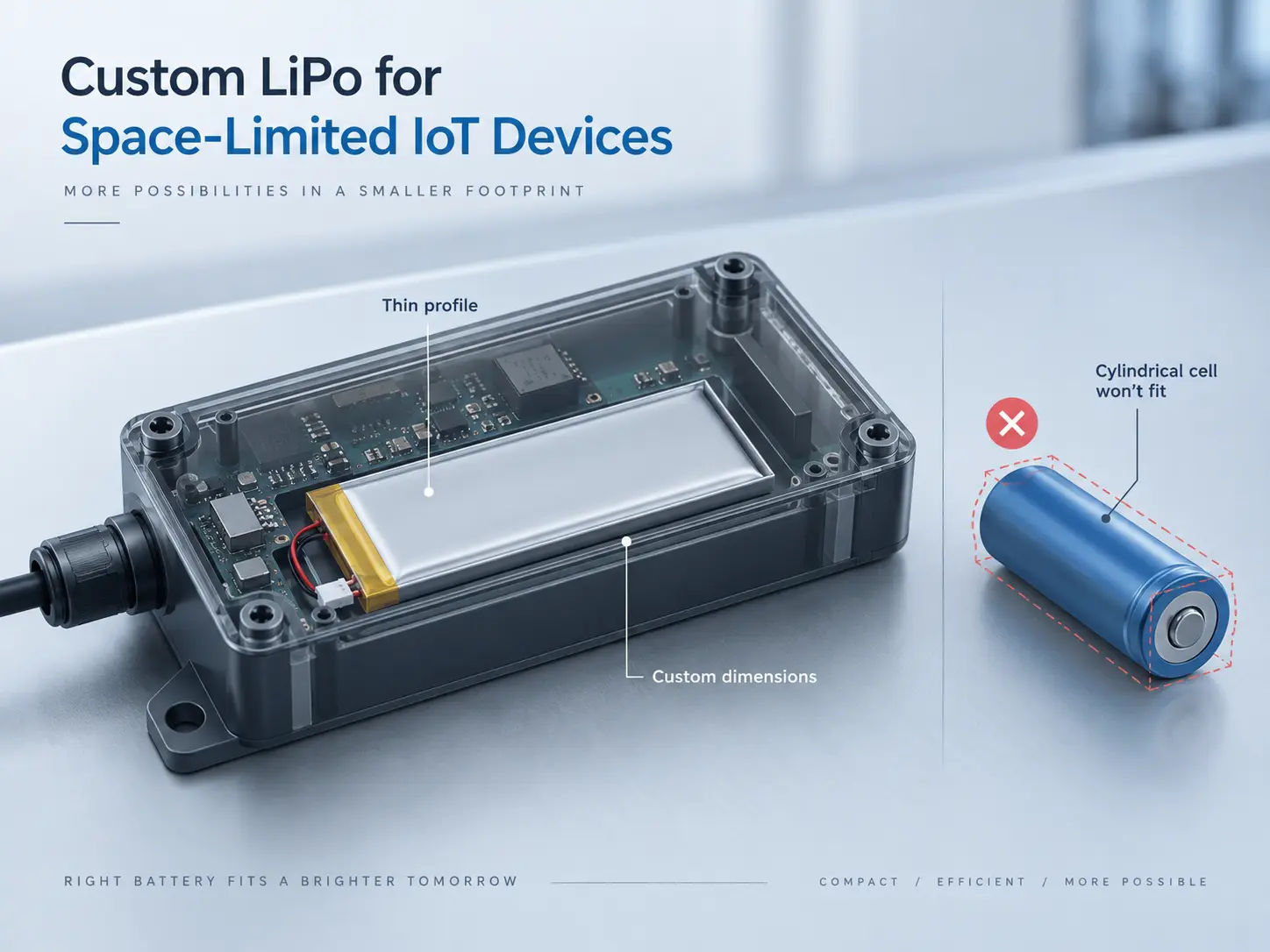
A U.S. electronics manufacturer needed a 3.7V battery for a compact IoT device, with only 13 × 45 × 66 mm of available internal space.
Because the 13 mm height could not efficiently accommodate a cylindrical cell, we developed a custom 124565 LiPo battery to maximize capacity within the available space.
Final Solution
- Cell size: 12 × 45 × 65 mm
- Pack size: 12 × 45 × 66 mm
- Voltage: 3.7V, 1S1P
- Capacity: 2450mAh
- Continuous discharge: 0.5C
- PCM: overcharge, over-discharge, short-circuit protection
- Wire: two wires, 50 mm
This case shows the key advantage of a custom LiPo battery: maximizing usable capacity when product space is tightly constrained.
4. LiPo vs Li-ion Discharge Rate: Do Not Approve a Battery From C-Rate Alone
It is common to hear that LiPo batteries always provide higher discharge rates than Li-ion batteries.
That is too broad.
Some high-discharge LiPo batteries are designed for very high current and may be advertised at 20C, 30C, 50C, or higher. High-power cylindrical Li-ion cells also exist.
The right comparison is the exact cell under the actual load profile.
For sourcing, request:
Rated continuous discharge current.
Maximum or pulse discharge current.
Duration of the pulse-current rating.
Internal resistance.
Voltage sag under load.
Cell temperature rise.
Minimum discharge voltage.
Cycle-life data at the required current.
A headline C-rate is not enough.
For example, if a 2 Ah cell is rated at 20C:
2 Ah × 20C = 40 A
But that does not automatically mean 40 A is suitable for continuous production use. The rating still needs defined test duration, temperature, voltage cutoff, and cycle-life conditions.
For procurement, usable current under defined operating conditions matters more than the largest number printed on the specification sheet.
5. Why Drones and RC Products Often Use High-Discharge LiPo Batteries
Drones and RC systems can demand rapid changes in current during takeoff, acceleration, climbing, and maneuvering.
That favors batteries with:
low internal resistance, high peak-current capability, low weight, and strong power-to-weight performance.
This is why high-C-rate LiPo batteries are common in these applications.
However, a claimed 50C LiPo battery should still be verified.
The supplier should state whether 50C is continuous or burst, how long the burst lasts, what temperature limit applies, what cutoff voltage was used, and how the rating affects cycle life.
For OEM sourcing, supplier test curves are more valuable than a headline C-rating.
6. Li-ion vs LiPo Cycle Life: Define the Test Before Comparing Numbers
You will often see these numbers online:
Li-ion: 500–1,000+ cycles
LiPo: 300–500 cycles
They are useful as general market references, but not as purchase specifications.
Battery cycle life changes materially with:
Cell chemistry.
Maximum charge voltage.
Minimum discharge voltage.
Depth of discharge.
Charge rate.
Discharge rate.
Operating temperature.
Storage temperature.
End-of-life criterion.
"500 cycles" means little unless the supplier defines the remaining capacity after cycle 500.
For an RFQ, use a measurable requirement such as:
Cycle life: ≥500 cycles to ≥80% of initial rated capacity under the agreed charge/discharge profile at 25°C.
Then request the test curve.
That gives purchasing an acceptance criterion instead of a marketing claim.
7. LiPo vs Li-ion Battery Safety: Qualify the Complete Battery System
Both LiPo and Li-ion batteries can experience thermal runaway under severe overcharge, overheating, internal short circuit, manufacturing defects, or mechanical damage.[3]
Their mechanical behavior differs.
A cylindrical Li-ion cell uses a rigid metal can that provides stronger cell-level mechanical protection.
A LiPo pouch battery uses flexible laminated packaging and therefore needs adequate protection against puncture, crushing, excessive compression, sharp edges, and abnormal swelling.
For pack qualification, check:
- Overcharge protection.
- Over-discharge protection.
- Overcurrent protection.
- Short-circuit protection.
- Temperature sensing.
- Cell balancing where applicable.
- Mechanical isolation.
- Charger compatibility.
- Connector and wire current ratings.
- BMS or PCM design.
- Cell and lot traceability.
For portable rechargeable lithium batteries, IEC 62133-2 specifies safety requirements and tests for intended use and reasonably foreseeable misuse.[4]
For transportation, lithium cells and batteries must also meet applicable UN Manual of Tests and Criteria, Section 38.3 requirements.[5]
For procurement, these documents are part of supplier qualification-not paperwork to collect after the design is finished.
8. LiPo vs Li-ion Battery Cost: Compare Total System Cost
A standard 18650 Li-ion battery pack often has an advantage when the product already has enough space for cylindrical cells.
The format has a mature supply chain, standardized dimensions, and strong manufacturing scale.
A custom LiPo battery may require more engineering work because customization can include cell dimensions, tabs, PCM/BMS, NTC, wires, connectors, insulation, labeling, and pack construction.
That can increase development cost or MOQ.
However, unit price alone can give the wrong answer.
A custom pouch battery may reduce total product cost if it allows the engineering team to:
Reduce enclosure size.
Reduce product weight.
Eliminate separate cell holders.
Simplify assembly.
Avoid PCB redesign.
Use internal volume more efficiently.
The correct comparison is therefore:
Battery price + mechanical cost + electronics cost + assembly cost + certification cost + expected field-failure cost.
That is the number procurement should optimize.
9. LiPo vs 18650 Battery Pack: What Should Be in the RFQ?
A useful battery RFQ should allow two suppliers to quote the same technical requirement.
At minimum, include the following.
Electrical Requirements
Nominal voltage, maximum charge voltage, rated capacity, minimum usable energy, continuous discharge current, peak current, pulse duration, discharge cutoff voltage, and expected load profile.
Mechanical Requirements
Maximum length, width, thickness, weight, connector, wire length, wire exit direction, available swelling allowance, and enclosure constraints.
Environmental Requirements
Operating temperature, charging temperature, storage temperature, humidity, vibration, shock, and expected installation environment.
Lifecycle Requirements
Required cycle life, depth of discharge, remaining-capacity criterion, expected calendar life, and typical daily usage profile.
Safety and Compliance Requirements
Applicable IEC 62133-2, UN 38.3, UL, product-level certification, transportation, or regional regulatory requirements.
Commercial Requirements
Prototype quantity, annual volume, forecast, MOQ, tooling charges, target price, production lead time, warranty terms, and engineering-change control.
Without these inputs, a low quotation may simply mean the supplier is quoting a different battery.

10. When I Would Choose a Custom LiPo Battery
A custom LiPo battery makes sense when one or more of the following drive the design:
- The device must be thin.
- Battery length, width, or thickness is tightly constrained.
- Product weight is critical.
- The battery cavity is flat or non-standard.
- Custom wire, connector, NTC, or PCM configuration is required.
- High power-to-weight performance is important.
- The battery must be designed around the enclosure rather than the enclosure around the battery.
Typical applications include wearables, GPS trackers, medical electronics, IoT devices, drones, RC products, handheld electronics, and compact consumer products.
11. When I Would Choose an 18650 Li-ion Battery Pack
An 18650 Li-ion battery pack is usually the stronger option when:
- The enclosure has sufficient cylindrical-cell space.
- Mechanical robustness matters.
- Standard cell formats are preferred.
- Modular series-parallel construction is useful.
- Supplier diversification is important.
- The project benefits from established high-energy or high-power cylindrical cells.
- Pack cost and production scalability are key requirements.
Typical applications include power tools, industrial equipment, robotics, portable power systems, backup systems, and larger battery packs.
12. LiPo vs Li-ion Battery: Procurement Bottom Line
For purchasing, the decision can be reduced to this:
Choose custom LiPo for packaging flexibility. Choose cylindrical Li-ion for format standardization.
Then validate the exact cell.
Do not approve a battery based only on:
mAh, C-rate, chemistry name, or unit price.
Approve it based on:
Wh, load profile, current capability, temperature rise, cycle-life data, protection architecture, mechanical fit, compliance documentation, supplier traceability, and total system cost.
That is the information that determines whether the battery will work in production.
Frequently Asked Questions About LiPo vs Li-ion Batteries
01. What is the difference between LiPo and Li-ion batteries?
In most commercial applications, the main difference is cell construction. LiPo batteries commonly use flexible pouch packaging, while conventional Li-ion batteries may use cylindrical or prismatic rigid housings. Both belong to the broader lithium-ion battery family.[1]
For procurement, focus on mechanical fit, electrical performance, cycle life, safety, and supplier capability-not the label alone.
02. Which is better, LiPo or Li-ion?
Choose LiPo when custom dimensions, low weight, or thin packaging are the priority.
Choose cylindrical Li-ion, including 18650 battery packs, when standardized geometry, mechanical robustness, modularity, and supply-chain maturity are more important.
There is no useful universal winner outside a defined application.
03. Does Li-ion have a higher energy density than LiPo?
Energy-oriented cylindrical cells often achieve high specific energy, while many LiPo pouch cells prioritize geometry or power capability. However, pouch-format lithium-ion cells can also reach high energy density.[2]
Compare the exact cells and calculate pack-level Wh/kg and Wh/L rather than relying on format alone.
04. Can you charge a LiPo battery with a Li-ion charger?
Only if the charging profile matches the exact battery specification.
Many LiPo and Li-ion cells use CC/CV charging, but maximum charge voltage, current, temperature limits, and balancing requirements must match the cell and pack design.
Do not select a charger simply because both packs are labeled "3.7 V lithium."
05. Are LiPo batteries safer than Li-ion batteries?
Neither format should be treated as inherently safer in every application.
Both can experience thermal runaway under severe abuse or defect conditions.[3]
Cylindrical cells provide stronger rigid mechanical protection. LiPo pouch batteries need more enclosure-level protection against puncture, compression, and swelling.
Safety must be evaluated at system level.
06. How long do LiPo batteries last compared with Li-ion batteries?
Typical market references often show 300–500 cycles for some LiPo products and 500–1,000+ cycles for some cylindrical Li-ion products, but these are not universal limits.
The supplier's test conditions matter more than the headline number.
Specify cycle life as a measurable requirement, such as ≥500 cycles to ≥80% remaining capacity under defined test conditions.
07. Why do drones and RC products use LiPo batteries?
These products require high peak current and low weight.
A high-discharge LiPo battery can provide a strong power-to-weight ratio, low internal resistance, and rapid current delivery, which suits motors and dynamic loads.
Any advertised 20C, 30C, or 50C+ rating should still be verified against temperature, duration, voltage cutoff, and cycle-life data.
08. What does LiPo stand for?
LiPo means Lithium Polymer or Lithium-ion Polymer.
Commercially, the term usually refers to flexible lithium-ion pouch cells using polymer- or gel-related electrolyte construction.[1]
09. Can a damaged LiPo battery be repaired?
A punctured, severely swollen, mechanically damaged, or electrically compromised LiPo battery should not be reused as a production cell.
It should be isolated and handled according to the manufacturer's safety instructions and applicable local recycling or disposal rules.
10. Is Li-ion heavier than LiPo?
Not necessarily at system level.
A LiPo pouch cell can reduce packaging mass because it does not use the same rigid metal can as a cylindrical cell.[1]
Total pack weight still depends on capacity, chemistry, BMS, wiring, protection materials, and enclosure design.
11. How should LiPo vs Li-ion batteries be stored?
Follow the cell manufacturer's storage specification.
Many LiPo batteries are stored around 3.80–3.85 V per cell for extended periods, but this should not be applied blindly to every lithium-ion chemistry.
Storage temperature and state of charge both affect aging.
12. What are the main disadvantages of LiPo batteries?
For procurement, the main disadvantages of a custom LiPo battery are usually higher customization effort, lower cell-level mechanical protection, swelling allowance requirements, potential MOQ or tooling constraints, and greater dependence on enclosure design.
Do not automatically classify short cycle life or low energy density as LiPo disadvantages; both depend on the specific cell.
13. Which battery has a longer cycle life, LiPo or Li-ion?
Packaging format alone does not determine cycle life.
Compare supplier cycle curves under the same charge voltage, depth of discharge, current, temperature, and end-of-life criterion.
Without the same test conditions, cycle-life numbers are not directly comparable.
Conclusion
For a purchasing engineer, LiPo vs Li-ion battery selection is not a chemistry popularity contest.
A custom LiPo battery is strongest when packaging flexibility, low weight, and custom dimensions drive the product.
An 18650 or other cylindrical Li-ion battery pack is strongest when standardization, mechanical robustness, modularity, and supply-chain flexibility drive the program.
Before placing an order:
- Define the load profile.
- Compare energy in Wh.
- Verify continuous and peak current.
- Set a measurable cycle-life requirement.
- Review mechanical integration.
- Confirm protection architecture.
- Verify compliance documents.
- Review supplier traceability and change control.
- Compare total system cost.
Qualify the exact cell first. Compare price second.
References
[1] Battery University, BU-206: Lithium-polymer: Substance or Hype? Cadex Electronics. Technical discussion of lithium-polymer construction, lithium-ion relationship, pouch packaging, electrolyte characteristics, weight, swelling, and charging behavior.
[2] U.S. Department of Energy, Vehicle Technologies Office, Development of High-Performance Lithium-ion Cell Technology for Electric Vehicle Applications. Published cell-development data illustrating that specific energy depends on chemistry and cell engineering rather than packaging format alone.
[3] Federal Aviation Administration, PackSafe - Lithium Batteries, together with FAA lithium-battery safety guidance addressing thermal runaway and abnormal battery conditions.
[4] International Electrotechnical Commission, IEC 62133-2:2017 + AMD1:2021 - Secondary Cells and Batteries Containing Alkaline or Other Non-Acid Electrolytes - Safety Requirements for Portable Sealed Secondary Cells, and for Batteries Made From Them, for Use in Portable Applications - Part 2: Lithium Systems.
[5] United Nations Economic Commission for Europe, UN Manual of Tests and Criteria, Part III, Subsection 38.3 - Lithium Metal and Lithium-Ion Batteries.