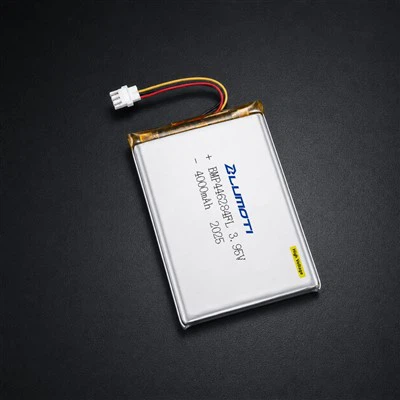


Hey there! As a supplier of Pouch Curved Lipo Batteries, I often get asked whether it's better to connect these battery cells in series or parallel. It's a pretty common question, and the answer isn't as straightforward as you might think. So, let's dive right in and explore the ins and outs of series and parallel connections for Pouch Curved Lipo Battery cells.


Understanding the Basics: Series vs. Parallel Connections
First things first, let's quickly go over what series and parallel connections mean. When you connect battery cells in series, you're basically stacking them up one after another. The positive terminal of one cell is connected to the negative terminal of the next cell. This has the effect of increasing the overall voltage of the battery pack, while the capacity (measured in ampere-hours, or Ah) remains the same.
On the other hand, when you connect battery cells in parallel, you're connecting all the positive terminals together and all the negative terminals together. This increases the overall capacity of the battery pack, but the voltage remains the same as that of a single cell.
The Pros and Cons of Series Connections
Pros
- Higher Voltage: One of the biggest advantages of connecting Pouch Curved Lipo Battery cells in series is that you can achieve a higher voltage. This is great for applications that require a higher voltage to operate, such as electric vehicles, power tools, and some high-power electronics. For example, if you have three Pouch Curved Lipo Battery cells with a voltage of 3.7V each, connecting them in series will give you a total voltage of 11.1V.
- Simpler Wiring: In a series connection, the wiring is relatively simple. You just need to connect the positive terminal of one cell to the negative terminal of the next cell, and you're good to go. This can make the installation and maintenance of the battery pack a lot easier.
- Efficiency: In some cases, operating at a higher voltage can be more efficient. For example, in an electric vehicle, a higher voltage can reduce the current flowing through the wires, which in turn reduces the power losses due to resistance. This can lead to better overall performance and longer battery life.
Cons
- Balancing Requirements: When you connect battery cells in series, it's important to ensure that all the cells are balanced. This means that each cell in the series string should have the same voltage and capacity. If one cell has a lower voltage or capacity than the others, it can become overcharged or over-discharged, which can damage the cell and reduce the overall performance of the battery pack. Balancing can be achieved through a battery management system (BMS), but this adds to the cost and complexity of the battery pack.
- Failure Risk: If one cell in a series connection fails (e.g., due to a short circuit or internal damage), the entire battery pack will stop working. This is because the current flow is interrupted, and the other cells can't continue to supply power. This can be a major drawback in applications where reliability is critical.
The Pros and Cons of Parallel Connections
Pros
- Higher Capacity: The main advantage of connecting Pouch Curved Lipo Battery cells in parallel is that you can increase the overall capacity of the battery pack. This is great for applications that require a long runtime, such as portable electronics, drones, and backup power systems. For example, if you have three Pouch Curved Lipo Battery cells with a capacity of 2000mAh each, connecting them in parallel will give you a total capacity of 6000mAh.
- Redundancy: In a parallel connection, if one cell fails, the other cells can still continue to supply power. This means that the battery pack can still function, although its capacity will be reduced. This can provide a higher level of reliability and safety in applications where uninterrupted power supply is important.
- Easier Balancing: Balancing is generally easier in a parallel connection compared to a series connection. This is because the cells in a parallel connection are all at the same voltage, and the main concern is to ensure that the current is evenly distributed among the cells. This can be achieved through simple wiring and current-sharing techniques, without the need for a complex battery management system.
Cons
- Lower Voltage: One of the main disadvantages of connecting Pouch Curved Lipo Battery cells in parallel is that the voltage remains the same as that of a single cell. This means that if your application requires a higher voltage, you'll need to connect the battery cells in series as well. This can add to the complexity and cost of the battery pack.
- Increased Wiring: In a parallel connection, you need to connect all the positive terminals together and all the negative terminals together. This requires more wiring compared to a series connection, which can make the installation and maintenance of the battery pack more difficult.
Which is Better: Series or Parallel?
So, which is better: connecting Pouch Curved Lipo Battery cells in series or parallel? Well, it depends on your specific application and requirements. Here are some factors to consider when making your decision:
- Voltage Requirements: If your application requires a higher voltage, then connecting the battery cells in series is the way to go. On the other hand, if your application can operate at a lower voltage, then connecting the battery cells in parallel can give you a higher capacity and longer runtime.
- Capacity Requirements: If you need a higher capacity battery pack, then connecting the battery cells in parallel is the better option. However, if your capacity requirements are relatively low, then a series connection may be sufficient.
- Reliability Requirements: If reliability is a major concern, then a parallel connection may be more suitable. This is because the redundancy provided by a parallel connection can ensure that the battery pack continues to function even if one cell fails. However, if you're willing to accept a higher risk of failure in exchange for a higher voltage, then a series connection may be acceptable.
- Cost and Complexity: Series connections generally require a battery management system (BMS) to ensure proper balancing, which can add to the cost and complexity of the battery pack. Parallel connections, on the other hand, may require more wiring but can be simpler to balance. Consider your budget and the level of complexity you're willing to deal with.
Our Pouch Curved Lipo Batteries
At our company, we offer a wide range of Pouch Curved Lipo Battery solutions to meet your specific needs. Whether you need a high-voltage battery pack for an electric vehicle or a high-capacity battery pack for a portable electronics device, we've got you covered.
In addition to our Pouch Curved Lipo Batteries, we also offer other types of lithium-ion batteries, such as Pouch Bottle Shaped Lipo Battery, Ultra Thin Lithium Polymer Battery, Pouch Ultra Narrow Polymer Battery, and Pouch U Shaped Lipo Battery. Our batteries are designed to provide high performance, reliability, and safety, and we can customize them to meet your specific requirements.
Get in Touch
If you're interested in learning more about our Pouch Curved Lipo Batteries or any of our other battery products, please don't hesitate to get in touch. Our team of experts is always happy to answer your questions and help you find the right battery solution for your application. We can also provide you with a quote and samples, so you can test our products before making a purchase.
So, what are you waiting for? Contact us today and let's start a conversation about your battery needs!
References
- Linden, D., & Reddy, T. B. (2002). Handbook of Batteries. McGraw-Hill.
- Tse, C. K., & Chung, H. S. H. (2016). Power Electronics: Converters, Applications, and Design. John Wiley & Sons.