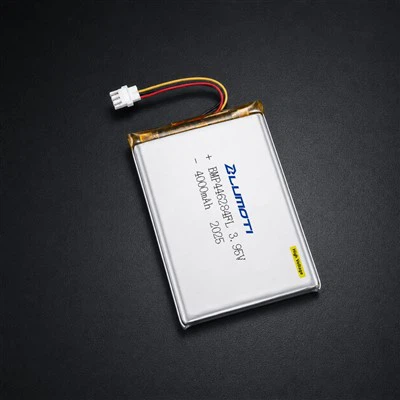


Alright, let's dive right into the world of semi - solid lipo batteries and talk about state - of - health (SOH) monitoring methods. As a semi - solid lipo battery supplier, I've seen firsthand how important it is to keep tabs on the health of these batteries.
Why SOH Monitoring Matters
Semi - solid lipo batteries are becoming more and more popular in various applications, from electric vehicles to portable electronics. Their high energy density and relatively good safety features make them a top choice. But like any other battery, they degrade over time. Monitoring the SOH helps us understand how much life is left in the battery, predict when it might need replacement, and ensure its safe and efficient operation.
Common SOH Monitoring Methods
1. Voltage - based Method
One of the simplest ways to monitor the SOH of semi - solid lipo batteries is by looking at their voltage. The voltage of a battery is closely related to its state of charge (SOC) and health. As the battery degrades, its open - circuit voltage (OCV) at a given SOC will change. For example, a healthy battery might have an OCV of around 3.7V at 50% SOC, but as it gets older, this voltage might drop slightly.
However, the voltage - based method has its limitations. The voltage can be affected by factors like temperature, current, and internal resistance. So, it's not always a super accurate way to determine the SOH on its own.
2. Capacity Testing
Capacity testing is a more direct way to measure the SOH. It involves fully charging the battery and then discharging it at a constant current until it reaches its cut - off voltage. The amount of charge that can be extracted from the battery during this process is its actual capacity.
By comparing the actual capacity with the battery's rated capacity, we can calculate the SOH. For instance, if a battery has a rated capacity of 100Ah and the actual capacity measured is 80Ah, then the SOH is 80%. This method is quite accurate, but it's time - consuming and requires specialized equipment.
3. Electrochemical Impedance Spectroscopy (EIS)
EIS is a more advanced technique for SOH monitoring. It measures the impedance of the battery over a range of frequencies. The impedance of a battery is related to its internal resistance, which changes as the battery degrades.
As the battery ages, the internal resistance increases due to factors like electrode degradation, electrolyte decomposition, and the formation of solid - electrolyte interphase (SEI) layers. By analyzing the impedance spectrum, we can get insights into the different electrochemical processes happening inside the battery and estimate its SOH.


The advantage of EIS is that it can provide detailed information about the battery's internal state. But it also requires expensive equipment and complex analysis.
4. Data - driven Methods
With the development of artificial intelligence and machine learning, data - driven methods are becoming increasingly popular for SOH monitoring. These methods use historical data from battery operation, such as voltage, current, temperature, and charge - discharge cycles, to build models that can predict the SOH.
For example, a neural network can be trained on a large dataset of battery degradation data. Once trained, it can predict the SOH of a battery based on its current operating conditions. Data - driven methods are very flexible and can adapt to different types of batteries and operating environments. However, they require a large amount of high - quality data for training.
Our Semi - solid Lipo Batteries
At our company, we offer a range of high - performance semi - solid lipo batteries. We have the 330Wh/kg Semi - solid Polymer Battery, which has an extremely high energy density, making it ideal for applications where space and weight are critical.
We also have the 280Wh/kg Semi - solid Polymer Battery, which offers a good balance between energy density and cost. The 260Wh/kg Semi - solid Lipo Battery is a reliable option for more general - purpose applications.
If you need a battery with a bit more power, our 300Wh/kg Semi - solid Lipo Battery is a great choice. And for the most demanding applications, we have the 350Wh/kg Semi - solid Lithium Polymer Battery, which is at the cutting edge of battery technology.
Importance of SOH Monitoring for Our Customers
For our customers, SOH monitoring is crucial. Whether you're using our batteries in an electric vehicle or a portable device, knowing the health of the battery can help you plan maintenance, avoid unexpected failures, and get the most out of your investment.
We're committed to providing high - quality semi - solid lipo batteries and also offer support in SOH monitoring. We can help you choose the most suitable monitoring method based on your specific application and requirements.
Let's Talk
If you're interested in our semi - solid lipo batteries or have any questions about SOH monitoring, don't hesitate to reach out. We're here to help you find the best battery solutions for your needs. Whether you're a small business looking for reliable power sources or a large corporation in need of high - performance batteries, we've got you covered. Let's start a conversation and see how we can work together to meet your battery requirements.
References
- Arora, P., & White, R. E. (1998). Development of a method for predicting capacity fade in lithium - ion cells. Journal of the Electrochemical Society, 145(10), 3647 - 3654.
- Doyle, M., Fuller, T. F., & Newman, J. (1993). Modeling of galvanostatic charge and discharge of the lithium/polymer/insertion cell. Journal of the Electrochemical Society, 140(6), 1526 - 1533.
- Wang, C. Y., & Zhang, J. (2019). Recent advances in battery state of health monitoring and prognostics. Journal of Power Sources, 435, 226799.