
In today's fast-moving world of portable electronics, renewable energy, and modern hardware design, choosing the right power source can have a major impact on product performance.
For engineers, product developers, and business buyers, the li polymer battery vs lithium ion battery decision usually comes down to a few practical questions: How much energy do you need? How much space do you have? How much current does the product draw? And how long does the battery need to last?
Both technologies belong to the rechargeable lithium battery family. But they differ in cell construction, packaging, manufacturing, mechanical design, and real-world performance.
In this guide, we compare their core structures, performance characteristics, safety considerations, and typical applications. The goal is to help you choose the right custom battery solution for your product, with engineering insights from Blumoti Battery.
Understanding the Core Architecture: Li-Ion vs LiPo
To understand the difference between a lithium-polymer battery, often called a LiPo battery or Li-poly battery, and a standard lithium-ion battery, also known as a Li-ion battery or lithium ion cell, it helps to start with what is inside the cell. [1]

Lithium-Ion Batteries
Traditional cylindrical lithium-ion batteries, including common 18650 and 21700 cells, typically use a liquid electrolyte made from lithium salts such as LiPF₆ dissolved in organic carbonate solvents.[1]
The electrolyte carries lithium ions between the cathode and anode during charge and discharge.
These cells are normally housed in a rigid metal enclosure. Cylindrical cells typically use steel or nickel-plated steel, while many prismatic designs use aluminum or another rigid metal housing.[2]
The rigid casing provides mechanical protection, helps manage internal pressure, and supports standardized high-volume manufacturing.[2]
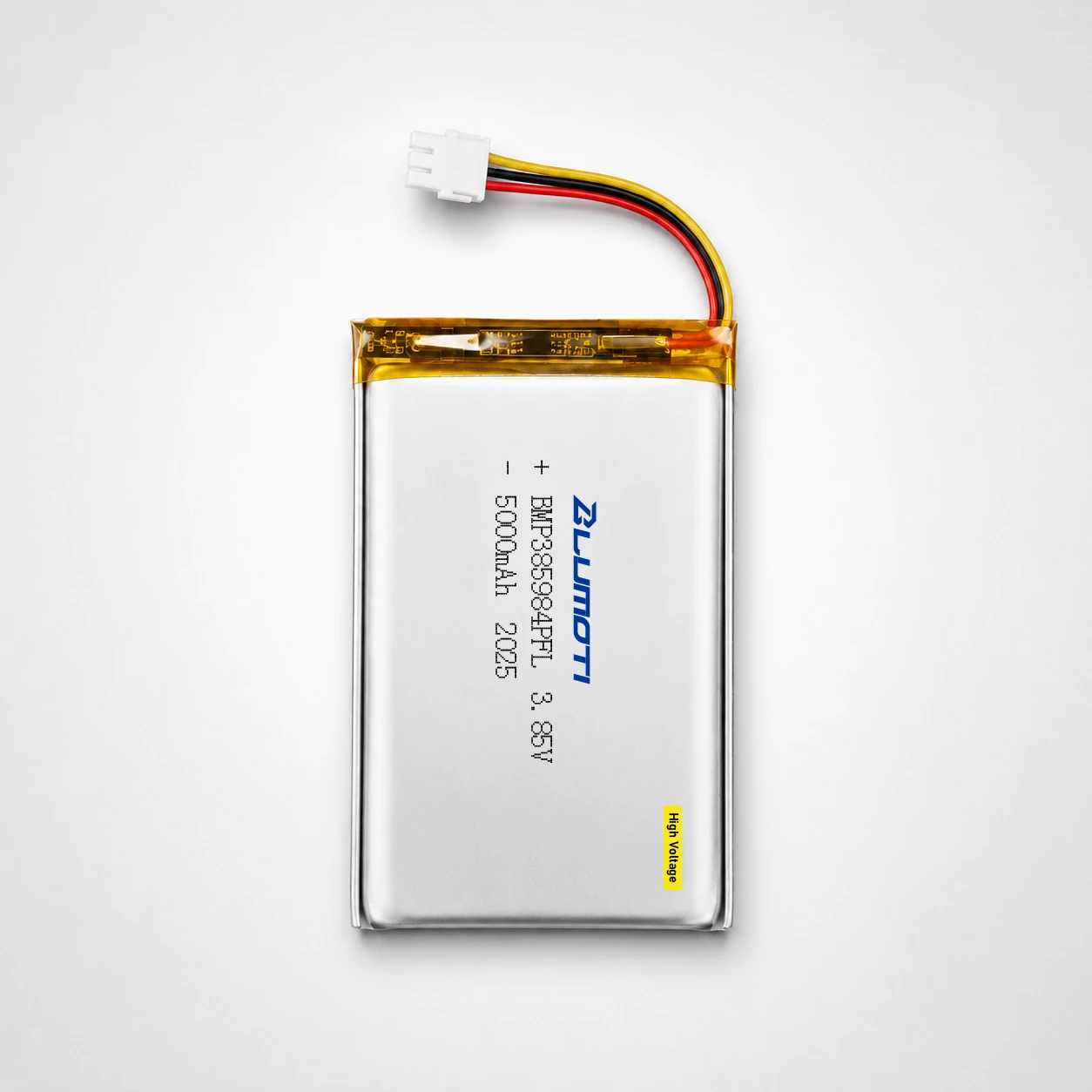
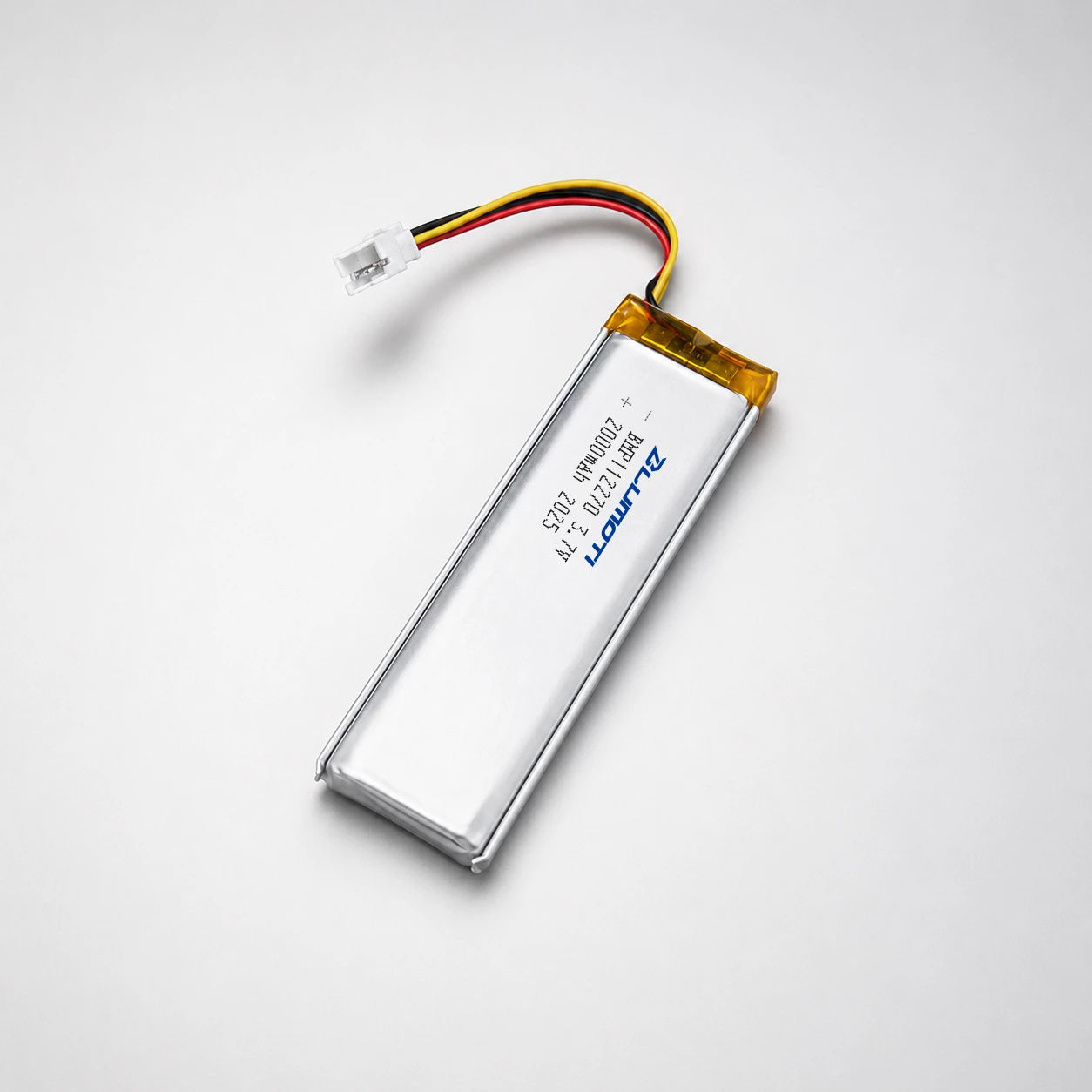
A lithium ion polymer battery typically uses a polymer-based separator/electrolyte system and is commonly packaged in a lightweight laminated aluminum pouch.[1][2]
Depending on the specific cell design, the electrolyte may be gel-like, polymer-supported, or contain liquid electrolyte immobilized within the separator structure.[1]
Because the cell does not require a heavy rigid steel can, manufacturers have much more flexibility in battery dimensions.
This is why pouch cells, polymer pouch batteries, and thin lithium polymer batteries are widely used in applications where thickness, weight, or custom dimensions matter.[2]

Summary of Key Structural & Empirical Differences
|
Key Parameter |
Lithium-Ion Battery (Li-Ion) |
Lithium Polymer Battery (LiPo) |
Scientific / Empirical Reference |
|
Electrolyte Type |
Liquid electrolyte |
Polymer-supported, gel-like, or related electrolyte system |
[1] |
|
Enclosure / Casing |
Rigid metal casing, typically cylindrical or prismatic |
Flexible laminated aluminum pouch |
[2] |
|
Form Factor Flexibility |
Mostly standardized shapes and dimensions |
Ultra-thin and custom-shaped battery options |
[2][3] |
|
Gravimetric Energy Density |
Commonly around 150–250 Wh/kg, depending on chemistry and design |
Commonly around 100–265 Wh/kg, depending on chemistry and design |
[4] |
|
Discharge Rate (C-Rate) |
Depends on cell design; many standard cells are optimized for moderate continuous discharge |
Specialized high-power cells can support 30C or higher |
[5] |
|
Cycle Life Longevity |
Common benchmarks can reach 500–1,000 cycles under controlled conditions |
Common pouch-cell benchmarks may fall in the 300–500-cycle range, depending on design and use |
[6] |
|
Leakage / Swelling Behavior |
Rigid casing contains electrolyte and internal gas until venting or failure |
Pouch expansion makes gas generation and swelling easier to observe |
[7] |
The numbers above should be treated as general engineering ranges, not universal specifications.
Cell chemistry, electrode design, charge voltage, temperature, depth of discharge, BMS settings, and manufacturing quality can all have a major impact on actual performance. [4][6]
Detailed Performance Analysis: Li Polymer vs Lithium Ion
When selecting a battery pack for commercial production, several engineering factors need to be evaluated.
- Gravimetric energy density, measured in Wh/kg, tells you how much energy a battery stores relative to its weight.
- Volumetric energy density, measured in Wh/L, tells you how much energy it stores relative to physical volume.[4]
Traditional rigid-cell lithium-ion batteries perform very well when the product can accommodate standardized cylindrical or prismatic cells.
Modern high-energy cylindrical cells can achieve strong cell-level volumetric energy density. This makes them a good fit for applications where maximum stored energy and standardized pack construction matter.[4]
Lithium polymer batteries offer a different advantage.
By removing the heavy outer steel can and avoiding the unused space created when round cells are placed inside rectangular housings, thin lithium polymer cells can make better use of the available space in slim electronic products.[2][4]
This becomes especially important in sub-5 mm device designs.
For a smartwatch, medical wearable, compact tracker, or ultra-thin consumer device, the best battery is often not the cell with the highest theoretical Wh/kg.
It is the battery that uses the available product envelope most efficiently.
If your product needs rapid power delivery, the maximum discharge C-rate becomes critical.
This is especially important for electric motors, UAVs, drones, RC devices, robotics, and other high-output applications.[5]
A high discharge rate polymer battery can be designed with larger current-collection tabs, optimized electrode structures, and low-resistance current paths.
These features help reduce internal impedance and voltage sag under heavy load.[3][5]
Specialized high-power LiPo batteries may support continuous discharge rates of 30C or higher, depending on cell chemistry, electrode construction, thermal conditions, and manufacturer specifications.[5]
This is one reason LiPo batteries are widely used in drones and RC applications.
Standard cylindrical Li-ion cells, on the other hand, are often an excellent choice for steady power delivery and long runtime.
It is important to note that the cell format alone does not determine discharge capability.
A high-power cylindrical lithium-ion cell may outperform an energy-focused pouch cell. Likewise, a purpose-built high-C-rate LiPo battery may deliver far more current than a standard cylindrical cell.
Always compare the actual continuous current, pulse current, internal resistance, voltage sag, and thermal data for the specific cell.
A common question is:
Do lithium-polymer batteries charge faster than lithium-ion batteries?
Not necessarily.
Charging speed depends on cell chemistry, electrode design, internal resistance, temperature, and the manufacturer's recommended charging limits.[3][5]
Some LiPo batteries designed for high-drain applications use optimized electrodes and low-resistance structures that allow higher charging C-rates.
Depending on the specific design, certain high-performance cells may support fast charging at 2C or above.[5]
But that does not mean every LiPo battery can be safely fast-charged.
Both Li-ion and LiPo batteries normally require a controlled CC/CV - Constant Current / Constant Voltage charging process.
They also need the correct charging voltage and current limits.
For commercial battery packs, a properly designed battery management system (BMS) is equally important.
Charging outside the cell manufacturer's specified limits can accelerate degradation and increase safety risk.
Battery service life is usually evaluated by the number of charge-discharge cycles the battery can complete before its capacity falls below a defined threshold.
A common benchmark is 80% State of Health, or 80% SOH.[6]
-
Lithium-Ion Cell Longevity
Under controlled conditions, standard cylindrical lithium-ion batteries are often associated with cycle-life ranges of roughly 500–1,000 cycles before reaching around 80% of initial capacity.[6]
Rigid mechanical construction can also provide strong physical support for the internal electrode assembly.
-
Lithium-Polymer Cell Longevity
Many soft pouch lithium polymer batteries are commonly rated in the 300–500-cycle range under typical test conditions.[6]
Pouch cells can experience dimensional changes and gas generation as they age. Mechanical support, thermal management, charge voltage, operating temperature, and depth of discharge can all affect long-term performance.[6][7]
These numbers should not be treated as a fixed rule.
A well-designed pouch cell operated under mild conditions can outlast a poorly managed cylindrical cell.
For engineering selection, always compare cycle-life data under the same charge rate, discharge rate, temperature, depth of discharge, and end-of-life criteria.
Safety Profiles, Thermal Stability, and Certifications
Battery safety depends on much more than whether a cell is labeled Li-ion or LiPo.
Safety validation generally involves electrical, thermal, and mechanical testing. Depending on the application and market, relevant requirements may include standards such as UL 1642 and IEC 62133-2, while lithium batteries intended for transport are subject to the applicable UN 38.3 testing requirements.[7][8]
-
Thermal Runaway & Overheating Mechanics
Lithium-ion battery thermal runaway involves a series of heat-generating reactions inside the cell.
As internal temperature rises, the Solid Electrolyte Interphase (SEI) can begin to degrade. Additional reactions involving the electrolyte, separator, electrodes, and other cell components may follow.[7]
SEI degradation is commonly associated with temperatures beginning roughly in the 80°C–120°C range, although the exact onset temperature depends on chemistry, state of charge, and cell construction.[7]
Separator shutdown behavior may occur at higher temperatures, often around 130°C for certain separator systems.[7]
If heat generation becomes faster than heat dissipation, the process can become self-sustaining.
In rigid cylindrical cells, gas generated during severe abuse or internal failure builds pressure inside the metal enclosure.
Quality cylindrical cells therefore commonly use engineered safety devices such as vents, shutdown mechanisms, or current-interrupt devices.[2][7]
-
Battery Swelling vs Leakage
Pouch-format LiPo batteries behave differently.
Gas generated by electrolyte decomposition or other degradation reactions can cause the laminated pouch to expand.[7]
This creates the familiar swollen polymer battery condition.
Because the pouch is flexible, swelling is often easier to see than internal pressure buildup inside a rigid cylindrical cell.
Visible swelling should be treated as a warning sign.
A swollen, punctured, leaking, or abnormally hot battery should be removed from service and handled according to the manufacturer's safety instructions.
While pouch construction can reduce the risk associated with free-flowing electrolyte leakage during normal operation, a LiPo battery can still leak if the pouch is punctured, torn, crushed, or otherwise damaged.[1][7]
-
BMS Protection Integration
OEM battery packs developed by Blumoti Battery can integrate multi-layer BMS protection based on the electrical requirements of the application.
Typical protection functions include:
- Over-temperature protection
- Overcharge protection
- Over-discharge protection
- Over-current protection
- Short-circuit protection
- Cell balancing where required
For compliance, it is important to separate BMS functionality from certification and transport requirements.
UN 38.3 covers design qualification testing for lithium cells and batteries intended for transport.[8]
IEC 62133-2 specifies safety requirements and tests for portable sealed secondary lithium cells and batteries containing non-acid electrolyte.[8]
UL 1642 is a widely used safety standard for lithium cells.[8]
The exact certification path depends on the battery design, finished product, target market, and application.
Target Applications: Choosing the Right Solution
When to Choose Lithium Polymer (LiPo)
Ultra-Thin and Wearable Electronics
Lithium polymer batteries are a strong option for smartwatches, health trackers, medical devices, and other products where thickness and form factor matter.
Their pouch construction allows manufacturers to develop thin and customized cell dimensions that would be difficult to achieve with standard cylindrical cells.[2][3]
Drones, UAVs, and RC Devices
LiPo batteries are widely used in aerial and RC platforms because these applications often require a strong power-to-weight ratio and high peak discharge current.[5]
Specialized high-discharge LiPo batteries can support discharge rates above 30C when properly designed for high-power operation.[5]
Slim Consumer Hardware
Smartphones, tablets, handheld electronics, and other slim devices benefit from pouch cells that can use flat rectangular spaces efficiently.
This gives mechanical engineers and industrial designers more freedom when working around displays, PCBs, cameras, sensors, and other internal components.
When to Choose Lithium-Ion (Li-Ion)
Energy Storage Systems (ESS) & Backup Power
Lithium-ion cells are widely used in energy storage systems (ESS) and backup-power applications because standardized cell formats can support scalable manufacturing, mature supply chains, and predictable pack architecture.[4][6]
In larger ESS projects, cell chemistry, thermal management, system-level cost, safety, and cycle life are usually more important than the simple LiPo-versus-Li-ion label.
Electric Vehicles (EVs) & E-Mobility
Standardized cylindrical formats such as 18650, 21700, and larger-format cylindrical cells are widely used in electric mobility applications.
Their standardized geometry supports automated manufacturing and repeatable pack assembly.[2][4]
Pouch and prismatic lithium-ion cells are also widely used in EV platforms, so cell format should be selected based on the overall battery-system architecture.
Power Tools & Industrial Equipment
Power tools and industrial equipment need strong mechanical durability and high current capability.
Rigid cylindrical lithium-ion cells are well suited to these environments because the metal casing provides mechanical protection against shock and vibration.[2]
High-power cylindrical cells can also deliver substantial discharge current, which is why they remain common in professional power tools.
Why Partner with Blumoti Battery for Custom Battery OEM/ODM?
Whether your product needs a high-capacity lithium ion battery pack or a custom-designed thin lithium polymer cell, the battery has to fit more than a capacity target.
It also needs to match the product's electrical, mechanical, thermal, safety, and production requirements.
Blumoti Battery provides custom battery OEM and ODM manufacturing services for commercial and industrial applications.
Custom Form Factors
Blumoti supports tailored battery dimensions, pouch sizing, pack layouts, wire positions, connector options, and voltage configurations.
This gives product teams more flexibility when working with tight or unusual internal spaces.
Integrated BMS Engineering
Custom battery packs can be designed with BMS protection functions based on the actual operating requirements of the device.
These may include overcharge, over-discharge, over-current, short-circuit, temperature, and cell-balancing protection.
Where applicable, battery development can also take relevant testing and compliance requirements such as UN 38.3, IEC 62133-2, and UL standards into account.[8]
Optimized Cost Efficiency
Battery cost is not only about cell price.
Pack architecture, materials, BMS design, welding, assembly, testing, certification, and production volume all affect the final cost.
A scalable battery design helps reduce unnecessary complexity while maintaining the required performance and safety targets.
Contact Blumoti Battery today to discuss your application with our engineering team and request a custom power solution for your next hardware project.
https://www.blumoti-battery.com/contact-us
References & Authoritative Sources
[1] Tarascon, J. M., & Armand, M.
"Issues and Challenges Facing Rechargeable Lithium Batteries." Nature, Vol. 414, pp. 359–367, 2001.
Used for: lithium-ion electrolyte fundamentals, polymer electrolyte systems, lithium battery chemistry, and general electrochemical architecture.
[2] Battery University / Cadex Electronics.
BU-series technical resources covering lithium-ion cell formats, cylindrical cells, prismatic cells, pouch cells, battery construction, and safety mechanisms.
Used for: rigid metal casing vs. pouch construction, form-factor differences, mechanical characteristics, and cell-format comparisons.
[3] Chen, M., & Rincon-Mora, G. A.
"Accurate Electrical Battery Model Capable of Predicting Runtime and I-V Performance." IEEE Transactions on Energy Conversion, Vol. 21, No. 2, pp. 504–511, 2006.
Used for: electrical battery behavior, internal resistance/impedance considerations, voltage response, and battery performance modeling.
[4] U.S. Department of Energy (DOE), Vehicle Technologies Office.
Battery R&D reports, EV battery performance targets, Battery Test Manual resources, and Energy Storage R&D publications.
Used for: gravimetric and volumetric energy-density benchmarks, EV battery performance, and large-scale lithium-ion energy-storage applications.
[5] Scrosati, B., & Garche, J.
"Lithium Batteries: Status, Prospects and Future." Journal of Power Sources, Vol. 195, No. 9, pp. 2419–2430, 2010.
Used for: lithium battery power performance, discharge-rate considerations, charging kinetics, and high-power lithium battery development.
[6] NASA Aerospace Battery Workshop Reports and Battery Aging Research.
NASA battery-workshop materials and related lithium-ion aging, cycle-life, and degradation research.
Used for: cycle-life benchmarks, State of Health (SOH), degradation factors, and comparisons of lithium-ion cell behavior under cycling.
[7] Finegan, D. P., et al.
"In-operando High-Speed Tomography of Lithium-Ion Batteries During Thermal Runaway." Nature Communications, Vol. 6, Article 6924, 2015; together with related NREL lithium-ion battery safety research.
Used for: thermal runaway mechanisms, internal structural failure, heat generation, gas evolution, and battery safety behavior.
[8] International Electrotechnical Commission (IEC), UL Solutions, and United Nations Economic Commission for Europe (UNECE).
IEC 62133-2: Safety Requirements for Portable Sealed Secondary Lithium Cells and Batteries; UL 1642: Standard for Lithium Batteries; UN Manual of Tests and Criteria, Part III, Subsection 38.3.
Used for: lithium-cell safety requirements, safety testing, and lithium battery transport design-qualification testing.