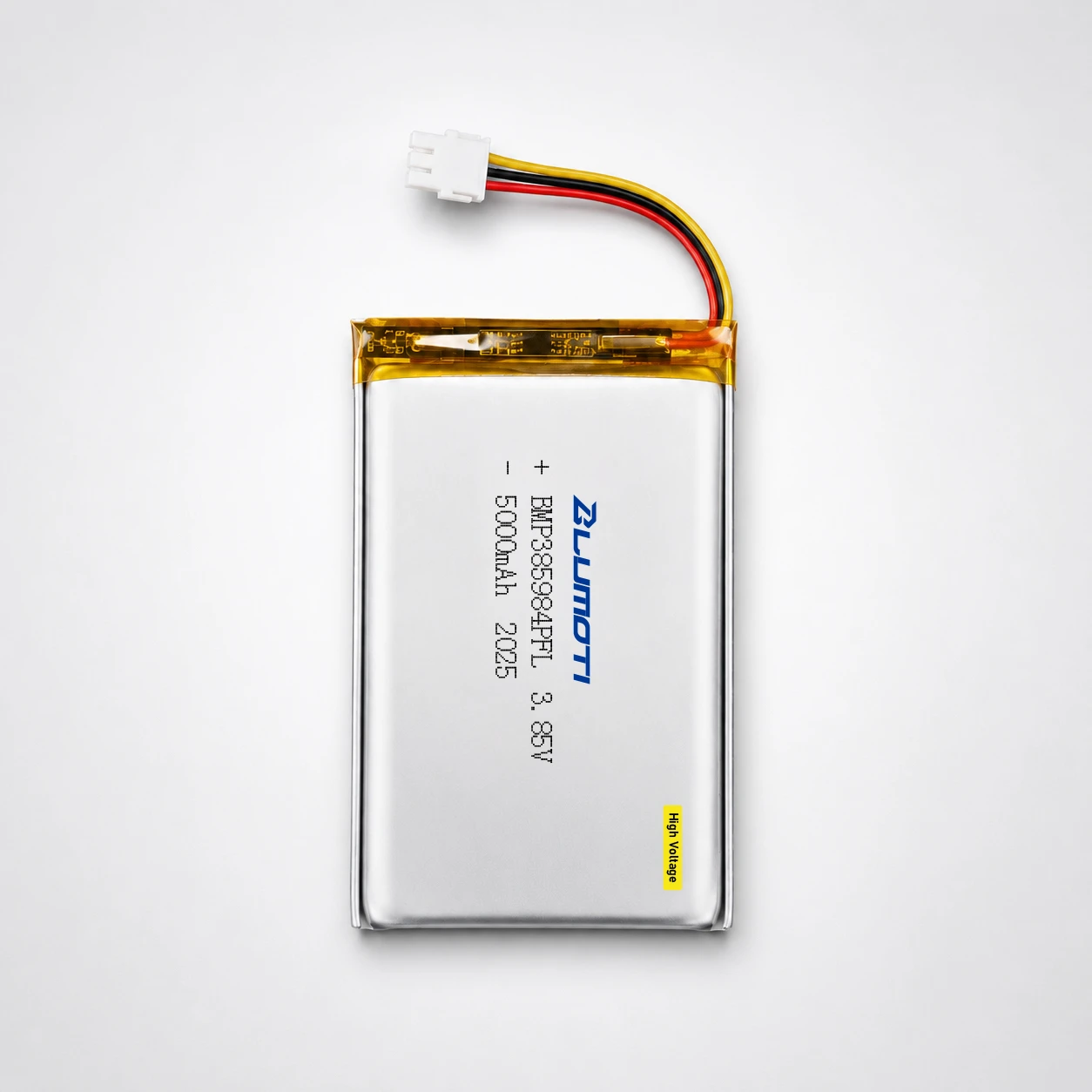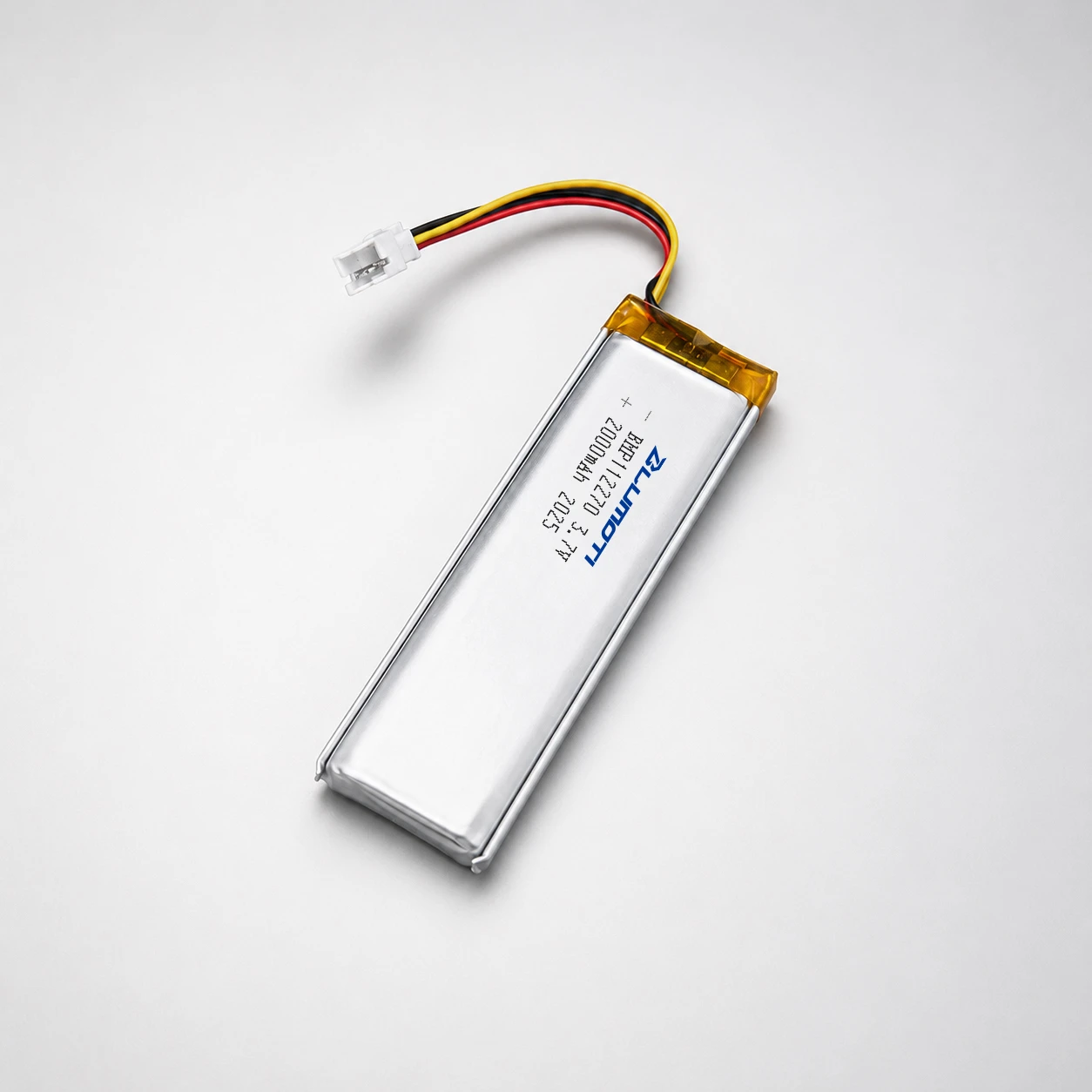

Quick Answer: What Buyers Need to Know About High Voltage LiPo Batteries
A high voltage lithium polymer battery, or LiHV battery, is a lithium-polymer cell designed to operate at a higher charge voltage than a conventional 3.7V LiPo battery.
For most sourcing projects, the key difference looks like this:
Standard 3.7V LiPo: typically 3.7V nominal / 4.20V maximum charge voltage.
3.8V LiPo battery: commonly 3.8V nominal / 4.35V maximum charge voltage [1].
3.85V LiPo battery: commonly available with 3.85V nominal / 4.40V maximum charge voltage, depending on the specific cell design [3].
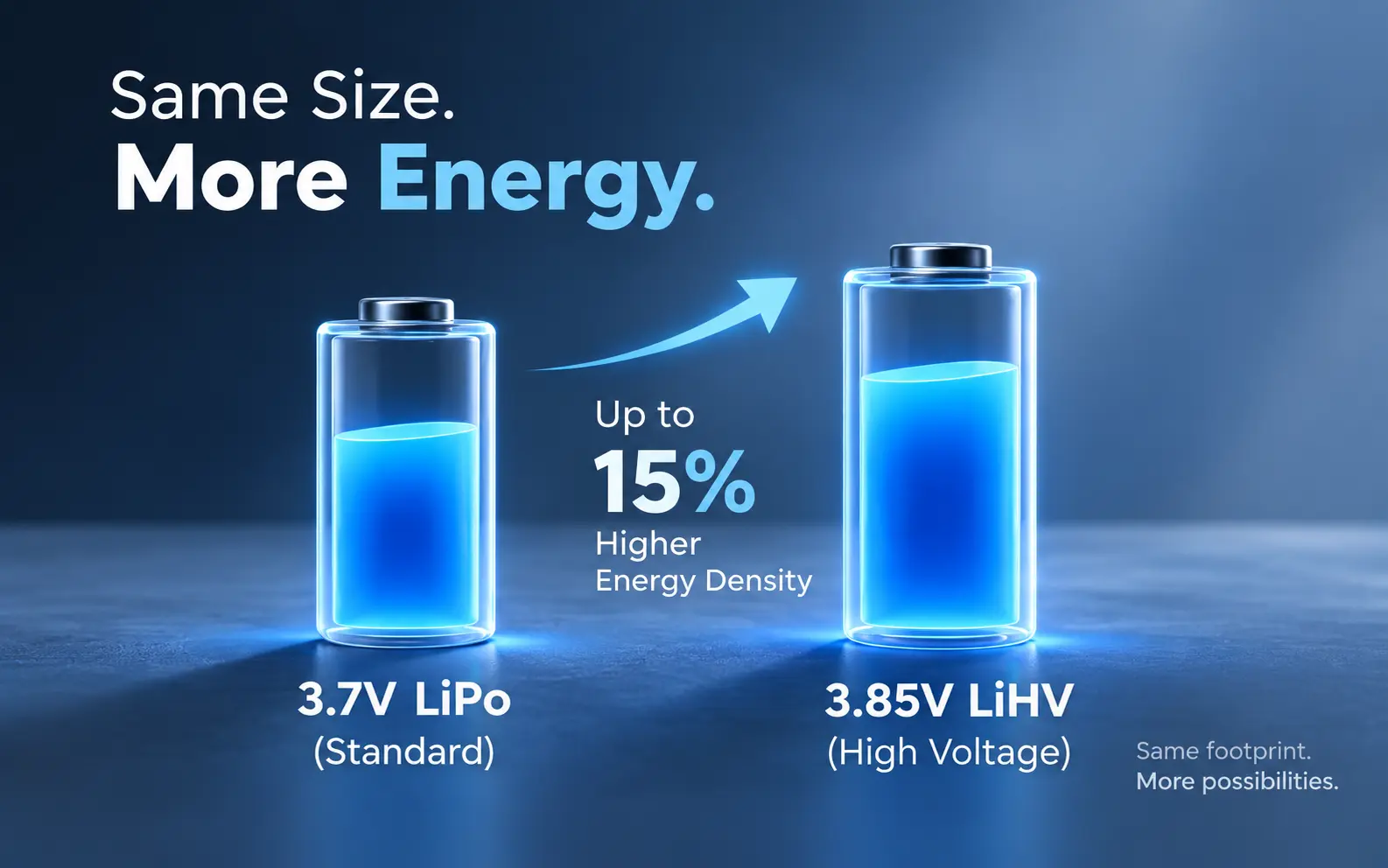
Why does this matter? Higher-voltage chemistry can deliver more usable watt-hours from a similar battery footprint. Some commercial LiHV cell families report roughly up to 15% higher energy density under comparable size and rate conditions [1].
For a purchasing engineer, however, nominal voltage is not enough to approve a battery.
You still need to verify maximum charge voltage, usable Wh, dimensions, weight, discharge current, cycle life, protection circuit, charger compatibility, operating temperature, certifications, and supplier consistency.
That is the difference between choosing a battery by its label and qualifying one for production.
A High Voltage Lithium Polymer (LiHV) battery is an advanced version of the conventional lithium-polymer battery.
A standard LiPo cell is generally rated around 3.7V nominal and charged to 4.20V per cell. A 3.8V LiPo battery is designed for a higher voltage platform and is commonly charged up to 4.35V per cell [1]. Commercial 3.85V LiPo batteries are also available with a 4.40V charging limit [3].
For buyers, the important point is not simply that 3.8V is higher than 3.7V.
The real purchasing question is:
How much additional usable energy can I get within my existing battery size and weight limit?
Battery energy is better compared in watt-hours:
Energy (Wh) = Nominal Voltage (V) × Capacity (Ah)
That is why two batteries with the same mAh rating do not necessarily provide the same total energy.
What Is the Maximum Charging Voltage of a 3.8V or 3.85V LiPo Battery?
The maximum charging voltage is one of the first specifications a buyer should confirm because it directly affects charger selection and system compatibility.
Typical industry configurations include:
Standard 3.7V LiPo: 4.20V per cell.
3.8V LiHV battery: 4.35V per cell [1].
3.85V LiHV battery: often 4.40V per cell, depending on the specific cell [3].
Blumoti, for example, publishes 3.8V LiHV cells with a 4.35V full-charge voltage, while commercial 3.85V Li-polymer cells are available with 4.40V maximum charging specifications.
Do not assume every 3.85V cell uses the same upper charge voltage. Higher-voltage lithium-ion cells also exist with other charge limits.
The approved cell datasheet-not the nominal-voltage label-should control your charger design.
LiHV vs LiPo Battery Voltage: What Actually Changes for the Buyer?
When comparing LiHV vs LiPo battery voltage, the main advantage of LiHV is a higher voltage operating window and potentially more usable energy within a similar physical envelope.
For compact OEM products, that can be useful when the mechanical team cannot simply make the battery thicker or larger.
A higher voltage platform can provide:
More stored energy within a constrained battery volume.
A higher initial operating voltage.
Potentially longer runtime when the complete system is optimized for the cell.
More flexibility when designing thin and lightweight electronics.
The tradeoff is that the charger, PCM/BMS, fuel gauge, product electronics, and qualification testing all have to match the selected cell.
From a procurement standpoint, that means a 3.8V high voltage LiPo battery should be evaluated as part of the complete power system-not as a drop-in upgrade based on voltage alone.
Comparison Table: 3.7V vs 3.8V vs 3.85V LiPo Batteries
|
Battery Specification |
Standard LiPo |
High Voltage LiPo |
High Voltage LiPo |
|
Nominal Voltage |
3.7V/cell |
3.8V/cell |
3.85V/cell |
|
Typical Maximum Charge Voltage |
4.20V/cell |
4.35V/cell [1] |
4.40V/cell [3] |
|
Energy Density |
Baseline |
Higher |
Higher |
|
Potential Energy Advantage |
Baseline |
Cell-dependent; some LiHV families report up to ~15% [1] |
Cell-dependent |
|
Charger Requirement |
Standard LiPo profile |
LiHV-compatible profile |
Charger matched to cell specification |
|
Storage Voltage |
Typically around 3.8V/cell |
Around 3.85–3.95V/cell depending on charger/cell specification [4] |
Follow cell manufacturer specification |
|
Common Applications |
General electronics, RC products |
Drones, wearables, compact electronics |
Smartphones, wearables, high-energy compact devices |
Buyer note: These figures describe common commercial configurations. They are not universal specifications. Always compare the actual supplier datasheet before approving a cell.
What Are the Advantages of Using 3.8V/3.85V High Voltage LiPo Batteries?
Choosing a 3.8V LiPo battery or 3.85V high voltage LiPo battery can make sense when your product needs more energy but has little room for a larger battery.
1. Higher Energy Density Without Increasing the Battery Footprint
This is usually the strongest commercial reason to consider LiHV.
Some high-voltage LiPo product families report approximately 15% higher energy density under the same size and discharge-rate conditions compared with conventional cells [1].
For a buyer, that can mean more runtime without redesigning the enclosure.
The number should still be verified against the exact cell you are sourcing. Do not apply a 10%–15% improvement claim to every 3.8V or 3.85V battery on the market.
2. Better Use of Limited Space
A high voltage lithium polymer battery is particularly valuable in products where every millimeter matters.
Typical examples include:
Smart wearables.
GPS trackers.
IoT devices.
Medical electronics.
Thin consumer electronics.
Smartphones.
Compact UAV systems.
If your mechanical envelope is already fixed, increasing energy density may be more practical than increasing battery dimensions.
3. Potentially Longer Runtime for Drones and Portable Devices
A common purchasing question is: does a higher voltage LiPo battery give longer flight time?
It can-but higher voltage alone does not guarantee longer flight time.
A LiHV battery charged to its rated upper voltage can start with more available energy than a comparable conventional LiPo cell. That may increase runtime if battery weight, internal resistance, motor efficiency, ESC behavior, propeller selection, and load profile are properly matched.
For drones, I would request actual performance data rather than accepting a simple "LiHV flies longer" claim.
Compare:
Battery weight.
Usable Wh.
Internal resistance.
Voltage sag.
Continuous discharge current.
Peak discharge current.
Runtime under your actual load profile.
That gives purchasing and engineering teams a much more useful comparison.
A UK wearable-device customer needed longer runtime without increasing the battery size.
The original design used a 3.7V 180mAh LiPo battery and provided about 7 days of runtime.
We upgraded it to a 3.85V 200mAh LiHV battery with a similar footprint. Nominal energy increased from 0.666Wh to 0.770Wh, approximately 15.6% higher.
After adapting the charging and power-management circuit for the higher LiHV charging voltage, the device runtime increased to about 8 days per charge, an improvement of roughly 14%.
Result: longer battery life without increasing the product size.

Best Practices: Charging and Storing Your LiHV Battery
A higher-voltage cell only delivers its intended performance when the charging system matches the battery specification.
For an OEM buyer, this is not just a user-maintenance question. It affects charger IC selection, protection thresholds, validation testing, warranty risk, and product safety.
How to Properly Charge a 3.85V LiHV Battery
If you are asking how to properly charge a 3.85V LiHV battery, start with the manufacturer's cell specification.
A commercial 3.85V Li-polymer cell may specify a 4.40V maximum charging voltage [3].
Your charging system should therefore be validated for:
The specified maximum charging voltage.
Correct CC/CV charging behavior.
Maximum and recommended charge current.
Overvoltage protection.
Temperature monitoring.
PCM/BMS thresholds.
Fuel-gauge configuration.
For multi-cell packs, also verify cell balancing and pack-level protection.
The simple rule is:
Match the charger to the battery datasheet-not just to the nominal voltage printed on the label.
Can I Use a Standard 3.7V Charger to Charge a 3.8V or 3.85V Battery?
This is where buyers need to be careful.
A charger limited to 4.20V may charge certain 3.8V or 3.85V LiHV batteries without exceeding their upper voltage limit, but it will not charge a 4.35V or 4.40V-rated cell to its full specified voltage.
That means some of the available capacity and energy will remain unused.
However, I would not automatically call this configuration compatible.
For a production design, confirm:
The cell manufacturer's approved charging range.
Charger IC behavior.
Charge termination voltage.
Protection-board thresholds.
Fuel-gauge calibration.
Product runtime requirements.
If your objective is to obtain the energy-density advantage of an LiHV cell, a 4.20V-only charging system may defeat part of the reason you selected the high-voltage battery in the first place.
What Happens If You Charge a Standard 3.7V LiPo to 4.35V?
Do not do this unless the cell manufacturer specifically rates the cell for that charging voltage.
A conventional 3.7V LiPo designed around a 4.20V maximum charge voltage should not simply be treated as a 3.8V LiHV battery.
Charging a lithium cell above its specified maximum voltage can accelerate degradation and can increase the risk of gas generation, swelling, overheating, or more serious failure.
IEC 62133-2 specifies safety requirements and testing for portable secondary lithium cells and batteries under intended use and reasonably foreseeable misuse [2].
For purchasing engineers, there is a broader lesson here:
Maximum charge voltage is a controlled cell specification. It should not be changed without supplier and engineering validation.
What Is the Best Storage Voltage for High Voltage Lithium Polymer Batteries?
For samples, pilot builds, spare batteries, or warehouse inventory, the best storage voltage for high voltage lithium polymer batteries is normally below full charge.
LiHV charger specifications commonly use a storage range around 3.85V–3.95V per cell, with 3.90V as a typical default [4].
For commercial storage, also control:
Storage temperature.
State of charge.
Inventory age.
Cell swelling.
Mechanical damage.
Short-circuit risk.
Production-lot traceability.
FIFO inventory management.
For an OEM program, always prioritize the battery manufacturer's approved storage conditions over a generic online storage recommendation.
Frequently Asked Questions About 3.8V and 3.85V LiHV Batteries
Q1:What Exactly Is a 3.8V LiPo Battery?
A 3.8V LiPo battery is a type of high voltage lithium polymer battery designed to operate at a higher voltage platform than a conventional 3.7V LiPo.
Many commercial 3.8V LiHV cells use a 4.35V full-charge voltage [1].
For buyers, the advantage is the possibility of higher usable energy without significantly increasing battery dimensions or weight.
Q2:Can I Replace a 3.7V Battery With a 3.8V or 3.85V Battery?
Sometimes, but it should not be treated as an automatic drop-in replacement.
Before replacing a 3.7V battery with a 3.8V or 3.85V lithium polymer battery, verify:
① Maximum charger voltage.
② Device input-voltage limits.
③ PCM/BMS thresholds.
④ Fuel-gauge configuration.
⑤ Connector and pinout.
⑥ Battery dimensions.
⑦ Continuous and peak load current.
⑧ Operating temperature.
A physical fit does not automatically mean electrical compatibility.
Q3:Is It Safe to Charge a 3.8V Battery Up to 4.35V?
Yes, if the specific 3.8V LiHV battery is rated by its manufacturer for a 4.35V maximum charge voltage.
Commercial 3.8V high-voltage cells with a 4.35V full-charge specification are widely available [1].
The key phrase is "rated for."
Do not use 4.35V simply because the battery is described as LiPo.
Q4:What Are the Key Differences Between LiHV and LiPo Batteries for Drones?
When comparing LiHV vs LiPo batteries for drones, an LiHV battery typically starts from a higher full-charge voltage and can provide more usable energy from a comparable battery envelope.
That can provide stronger initial voltage under load and may increase flight time.
But does a higher voltage LiPo battery give longer flight time? Not in every aircraft.
Actual results depend on battery weight, motor KV, propeller size, ESC configuration, internal resistance, voltage sag, discharge rate, payload, and flight profile.
For purchasing, compare actual flight-test results under the same aircraft configuration.
Q5:What Applications Typically Use 3.8V and 3.85V Lithium Polymer Batteries?
3.8V and 3.85V lithium polymer batteries are commonly considered for applications where high energy density and compact dimensions are important.
Typical applications include:
① Smartphones.
② Smartwatches and wearables.
③ Medical devices.
④ GPS trackers.
⑤ IoT devices.
⑥ FPV and UAV systems.
⑦ Thin portable electronics.
⑧ Other space-constrained OEM products.
The strongest use case is usually not "we need the highest voltage." It is:
We need more usable energy from the space available inside the product.
Conclusion: How Should a Purchasing Engineer Evaluate a High Voltage LiPo Battery?
Understanding what is a high voltage lithium polymer battery (3.8V & 3.85V) is useful, but nominal voltage alone should never drive the sourcing decision.
For a real OEM project, start with:
Available battery dimensions.
Required usable Wh.
Continuous and peak current.
Maximum charging voltage.
Battery weight.
Required cycle life.
Operating temperature.
Protection requirements.
Safety and transportation certification.
Annual production volume.
A 3.8V LiPo battery or 3.85V high voltage LiPo battery can provide a meaningful advantage when your product is space-constrained and needs more usable energy.
But the right LiHV solution is the one that works with the complete device architecture-not simply the battery with the highest voltage or the biggest mAh number.
At Blumoti Battery, we develop and manufacture custom lithium polymer batteries, including standard 3.7V cells and 3.8V / 3.85V high voltage LiPo battery solutions for OEM applications.
If you are evaluating a new battery project, send us your battery dimensions, voltage, capacity, continuous and peak current, connector, wire length, charge voltage, operating temperature, and estimated annual quantity.
We can then evaluate the battery against the device requirements instead of simply recommending a catalog cell.
Visit Blumoti Battery to discuss your custom battery project.
References & Technical Sources
[1] Grepow - High Voltage Battery (LiHV) and 3.8V/4.35V High Voltage LiPo Battery Cells. Published specifications identify 3.8V nominal / 4.35V full-charge LiHV cells and report approximately 15% higher energy density for certain high-voltage cell families under comparable conditions.
[2] International Electrotechnical Commission (IEC) - IEC 62133-2:2017 + AMD1:2021, Secondary Cells and Batteries - Safety Requirements for Portable Sealed Secondary Lithium Cells and Batteries. The standard specifies safety requirements and tests for portable secondary lithium systems under intended use and reasonably foreseeable misuse.
[3] LiPol Battery Co., Ltd. - 3.85V High Voltage Li-Polymer Battery Technical Specifications. Commercial 3.85V cell specifications include 4.40V maximum charging voltage configurations.
[4] SKYRC - D750 MIX / LiHV Charger Technical Documentation. Published charger specifications list an LiHV storage-voltage range of 3.85V–3.95V per cell, with approximately 3.90V per cell as the default storage setting