
Quick Answer
usually no.
Under comparable operating conditions, a conventional lithium-ion battery-especially a quality cylindrical cell such as an 18650 battery cell or 21700 lithium cell-will typically deliver a higher cycle-life ceiling than a standard lithium polymer battery. A common working range is 300–1,000+ cycles for Li-ion versus roughly 300–500 cycles for LiPo, measured to around 80% remaining capacity [1].
If you're comparing the two battery technologies beyond lifespan, see our complete Li Polymer Battery vs Lithium Ion Battery comparison.
But that number alone should not drive a sourcing decision.
For an OEM project, actual battery life depends on:
- Depth of discharge (DoD)
- Charge voltage and discharge cut-off voltage
- Continuous and peak discharge current
- C-rate
- Operating and storage temperature
- Charging speed
- Cell construction and mechanical support
- Battery Management System (BMS) design
If your product is thin, lightweight, or mechanically constrained, a custom lithium polymer battery may still be the better engineering choice even if its nominal cycle life is lower.
If long cycle life, mechanical durability, standardized sourcing, and cost efficiency are the priorities, a cylindrical lithium-ion battery pack is often the stronger option.
For procurement teams, the better question is not simply:
"Which chemistry lasts longer?"
It is:
"Which battery can meet our required cycle life, current load, temperature range, mechanical envelope, certifications, and target cost under our actual operating conditions?"
Lithium Polymer vs. Lithium-Ion Battery Lifespan: Direct Comparison
When evaluating lithium polymer vs lithium ion battery lifespan, compare the full operating profile-not just chemistry names.
|
Key Metric |
Lithium-Ion (Li-ion) |
Lithium Polymer (LiPo / Li-Poly) |
|
Typical Charge Cycle Life to 80% Capacity |
300 to 1,000+ full charge cycles [1] |
300 to 500 charge cycles [1] |
|
Calendar Lifespan |
3 to 5 years |
2 to 3 years |

These are general industry ranges, not guaranteed specifications.
A serious battery supplier should be able to provide the actual cell datasheet, cycle-life test conditions, charge/discharge rates, temperature conditions, and end-of-life criteria for the specific cell being quoted.
That matters far more than a generic "Li-ion vs. LiPo" claim.
What Actually Determines Battery Lifespan?
Whether you select a Li-ion battery or a LiPo battery, these operating parameters have a larger impact on service life than many buyers expect.
1. Depth of Discharge (DoD) and Voltage Cut-Off
Repeated deep discharge puts more stress on lithium-ion electrode materials.
Operating a lithium cell within a partial state-of-charge window-such as approximately 20% to 80% state of charge (SoC)-can significantly extend total cycle life compared with repeated full-depth cycling [1], [2].
For applications where maximum cycle life matters more than maximum runtime per charge, this can be a useful system-level strategy.
Also pay close attention to the discharge cut-off voltage.
Deep over-discharge below approximately 3.0V per cell can lead to irreversible degradation, including copper current-collector dissolution and potentially dangerous internal failure mechanisms [3].
Buyer specification tip
Do not ask a battery supplier only for "cycle life."
Specify the complete test condition:
- Charge voltage
- Charge current
- Discharge current
- Discharge cut-off voltage
- Test temperature
- Depth of discharge
- Capacity-retention threshold
For example:
≥500 cycles at 25°C, 0.5C charge / 0.5C discharge, to ≥80% of initial rated capacity.
That is a procurement specification.
"Long cycle life" is not.
2. Fast Charging and C-Rate Degradation
Fast charging is convenient, but it comes with a trade-off.
High charging current can increase polarization, internal heating, and the risk of lithium plating on the graphite anode [4].
That is particularly important when a product uses Quick Charge, USB-PD, or another high-power charging architecture.
If your product requires fast charging, provide the battery supplier with the actual charging profile.
Do not simply specify battery capacity.
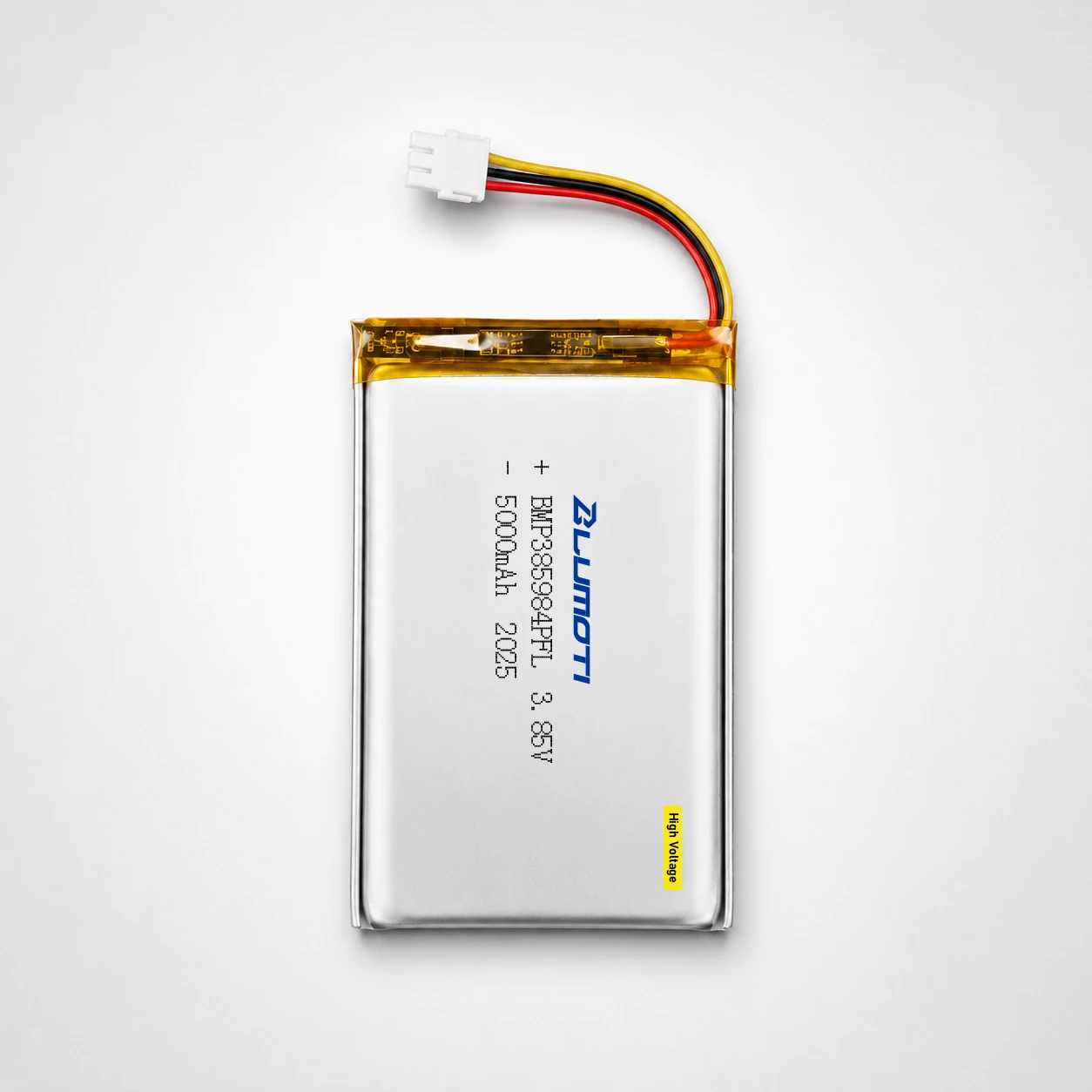
For example, a 3.7V 5,000mAh lithium polymer battery charged at 0.5C is operating under very different stress than the same cell charged at 1C or higher.
Before approving a battery, confirm:
- Maximum standard charge current
- Maximum fast-charge current
- Recommended charging temperature range
- •Maximum charge voltage
- Required termination current
- Expected cycle life at the intended charge rate
Fast charging should be treated as part of battery qualification, not added after the cell has already been selected.

3. Ambient Temperature and Storage Conditions
Storage conditions also affect lithium battery lifespan, even when the battery is not being cycled.
For longer-term storage:
- Recommended storage voltage: approximately 3.80V–3.85V per cell, or around 40%–50% state of charge [1].
- Recommended storage temperature: approximately 15°C to 25°C / 59°F to 77°F.
- Avoid storing lithium batteries fully charged for extended periods at elevated temperature.
A battery stored at high voltage in a hot warehouse, vehicle compartment, or unconditioned storage area may lose capacity before it is ever installed in the final product.
For importers and OEM buyers, storage specifications should therefore be part of the logistics plan-not just the engineering datasheet.
Frequently Asked Questions
01. Which Lasts Longer, Lithium-Ion or Lithium Polymer?
In typical applications, a conventional lithium-ion battery can deliver a higher cycle-life range than a standard lithium polymer battery.
Typical figures are approximately 300 to 1,000+ cycles for Li-ion and 300 to 500 cycles for LiPo, depending on the cell, operating temperature, charge rate, discharge rate, and end-of-life definition [1].
For an OEM project, request actual cycle-test data for the specific cell rather than relying on a chemistry-wide average.
02. Does Lithium Polymer Degrade Faster Than Lithium-Ion?
A lithium polymer pouch battery can be more susceptible to swelling, mechanical deformation, heat-related degradation, and rising internal resistance over repeated cycles [4], [5].
That does not mean every LiPo cell will degrade faster than every cylindrical Li-ion cell.
Actual life depends heavily on cell design and operating conditions.
If lifespan is critical, compare supplier data using identical:
- Temperature
- Charge current
- Discharge current
- Voltage limits
- Depth of discharge
- Capacity-retention criteria
Without matching test conditions, cycle-life comparisons are not meaningful.
03. Is Lithium Polymer Safer Than Lithium-Ion?
Neither battery type should be selected based on a simple "safer" label.
Both can be used safely when the cell, protection circuit, charger, mechanical enclosure, and thermal design are properly engineered.
Relevant requirements may include UL 1642, UN 38.3, and IEC 62133-2 [7].
A LiPo pouch cell may visibly swell under abnormal conditions, while cylindrical cells have rigid metallic housings. However, pouch cells also require protection against puncture, compression, and mechanical damage.
Both technologies can enter thermal runaway under severe abuse conditions.
For buyers, safety should be evaluated at the complete battery-pack and end-product level.
Looking for Reliable OEM/ODM Battery Solutions?
At Blumoti Battery, we develop custom lithium-ion battery packs, custom lithium polymer battery solutions, and industrial smart battery systems for OEM and ODM projects.
For an accurate battery recommendation, provide your:
Voltage + capacity + maximum dimensions + continuous/peak current + operating temperature + connector + protection requirements + certifications + estimated annual volume.
That gives the engineering team enough information to recommend a battery architecture that fits the product-not just a cell with the right mAh number.
References & Authoritative Sources
[1] Battery University / Cadex Electronics. BU-808: How to Prolong Lithium-based Batteries and BU-206: Lithium-polymer: Substance or Hype? Standard empirical references for cycle life, self-discharge, storage conditions, and voltage thresholds.
[2] National Renewable Energy Laboratory (NREL). Life Prediction Model for Grid-Connected Energy Storage Systems. Research covering the effects of depth of discharge (DoD) on calendar aging and cycle aging.
[3] Guo, L., et al. Research on degradation of lithium-ion battery current collectors, including anodic dissolution of copper foil under over-discharge conditions. Journal of Physics: Energy / Journal of Power Sources.
[4] Nature Energy / IEEE Transactions on Transportation Electrification. Research on lithium plating and degradation mechanisms in graphite anodes during high-rate and fast-charging operation.