
Quick Answer
For standard 4.20V lithium-ion chemistries, LiPo and Li-ion batteries typically use the same constant-current/constant-voltage (CC/CV) charging method. However, this does not mean their chargers are automatically interchangeable.
The correct charging profile depends on the exact cell chemistry, maximum charge voltage, allowable charging current, temperature limits, series-cell count, and pack protection design.
For a broader comparison of battery construction, energy density, discharge performance, and applications, read our Li Polymer Battery vs Lithium Ion Battery guide.
This article focuses specifically on charging parameters and charger compatibility to help engineers and purchasing teams qualify a battery and charger combination.
1. LiPo vs Li-Ion Charging Voltage
One of the most important charging specifications is the maximum voltage allowed for each cell.
Many standard LiPo and Li-ion cells have a nominal voltage of approximately 3.6–3.7V and a full-charge voltage of 4.20V per cell. However, the exact values depend on the selected cell.
► Standard Charging Voltage by Series Count
For battery packs using standard 4.20V cells:
- 1S battery: 4.20V full-charge voltage.
- 2S battery: 8.40V full-charge voltage.
- 3S battery: 12.60V full-charge voltage.
- 4S battery: 16.80V full-charge voltage.
- 6S battery: 25.20V full-charge voltage.
The charger must match both the maximum voltage per cell and the total number of cells connected in series.
► What About LiHV Batteries?
Some high-voltage LiPo (LiHV) cells are designed for 4.35V or 4.40V charging instead of the standard 4.20V.
A 4.35V or 4.40V charging profile must not be applied to a standard cell rated only for 4.20V.
Engineering takeaway: Never select a charger based only on the battery's nominal voltage or LiPo/Li-ion label. Confirm the exact maximum charge voltage and allowable tolerance in the cell datasheet.
2. CC/CV Charging: How LiPo and Li-Ion Batteries Charge
Standard rechargeable LiPo and Li-ion cells generally use a CC/CV charging process. The charger controls current first, then regulates voltage as the battery approaches full charge.
The complete process typically includes four stages.
Stage 1: Pre-Charge
If the cell voltage is below the normal fast-charge threshold, the charger may apply a reduced current before entering normal charging.
For some cells, this threshold is around 2.8–3.0V, but the exact value must follow the manufacturer's specification.
A charger should also include appropriate timeout and fault handling to prevent repeated charging attempts on an unsuitable or damaged cell.
Stage 2: Constant Current (CC)
During the CC stage, the charger supplies a regulated current while battery voltage rises toward the specified maximum.
For example, a 2200mAh battery charged at 1C receives a current of 2.2A.
Higher charging current can increase temperature rise and place additional demands on connectors, wiring, protection circuits, and thermal design.
Stage 3: Constant Voltage (CV)
When the battery reaches its specified charging voltage, the charger maintains that voltage while charging current gradually decreases.
For a standard 4.20V cell, the CV target is typically 4.20V, subject to the manufacturer's specified tolerance.
The CV stage is important because continuing to apply the full CC current would push the cell beyond its intended voltage limit.
Stage 4: Charge Termination
Charging normally ends when current falls below the specified termination threshold.
The exact termination current depends on the cell and charger design. It should not be assumed from a generic LiPo or Li-ion charging recommendation.
Continuous uncontrolled trickle charging is not an appropriate normal charging method for these batteries.
Engineering takeaway: When evaluating a charger, verify its pre-charge threshold, CC current, CV voltage accuracy, termination current, recharge behavior, and fault protection-not just its advertised output voltage and current.
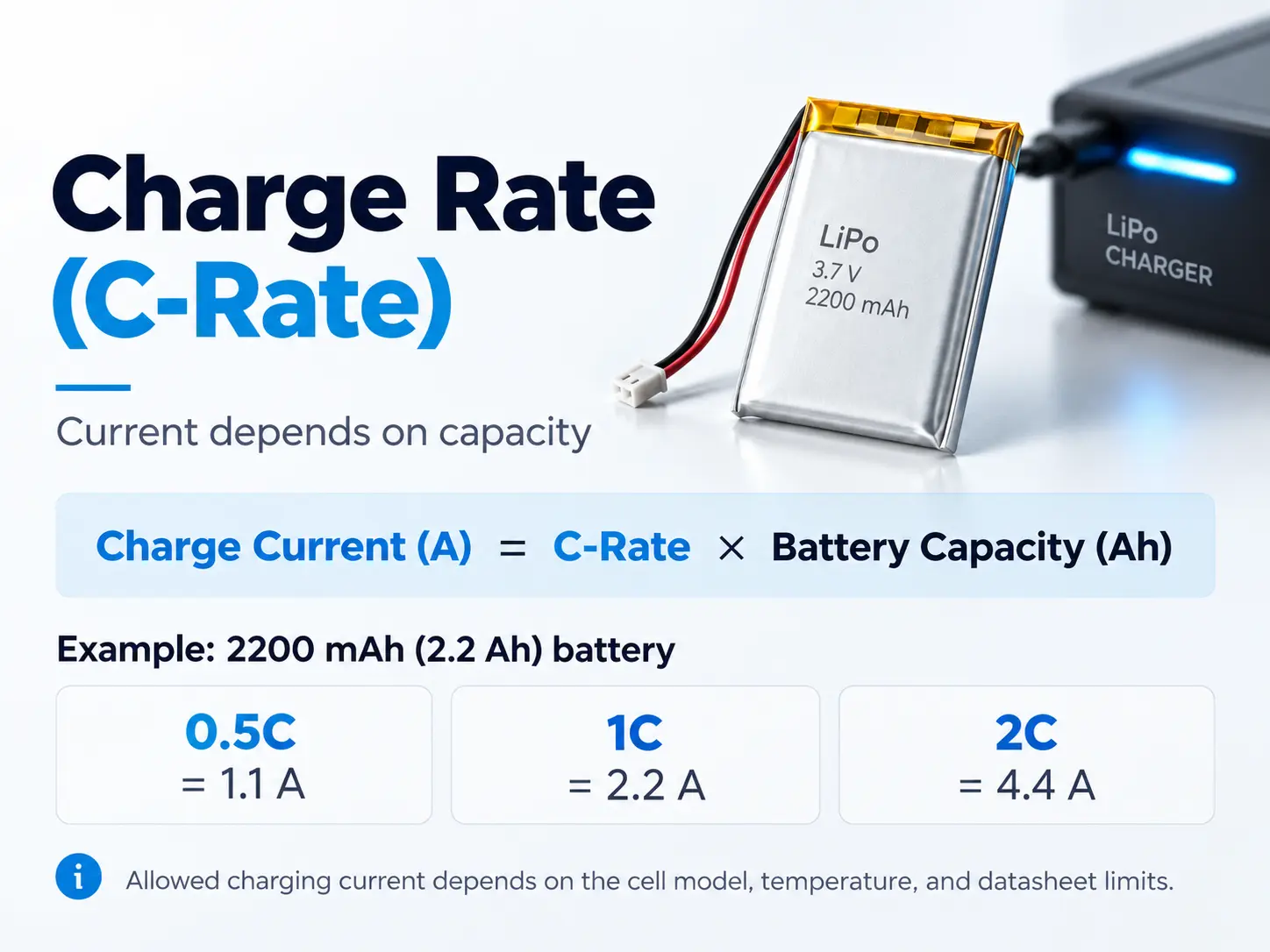
Charge rate is expressed as C-rate relative to battery capacity.
The calculation is:
Charge Current (A) = C-Rate × Battery Capacity (Ah)
For a 2200mAh (2.2Ah) battery:
0.5C charging = 1.1A.
1C charging = 2.2A.
2C charging = 4.4A.
However, calculating the current does not mean the battery is approved to accept it.
► Typical Charging Differences
Standard Li-ion cells: Many cylindrical 18650 and 21700 cells use charging rates around 0.5C–1C, although the actual limit varies by cell model.
Standard LiPo cells: A 1C charge rate is a common reference for many pouch batteries, but it is not a universal specification.
High-rate batteries: Certain specialized LiPo and Li-ion cells support higher charging rates when designed and qualified for those conditions.
A battery advertised with a high discharge C-rate does not necessarily support an equally high charging C-rate.
► What Should Buyers Verify?
Before approving a fast-charging battery, ask the supplier for:
Standard and maximum charging current, expressed in both amps and C-rate.
Permitted charging-temperature range and any current derating requirements.
Charging time and temperature-rise data at the proposed current.
Cycle-life data using the intended charging profile.
Procurement takeaway: Specify the required charging time and operating conditions in the RFQ instead of relying on general claims such as "fast-charging LiPo battery."
4. Charging Temperature: An Important Compatibility Factor
LiPo and Li-ion batteries must be charged within their approved temperature limits.
Low-temperature charging can increase the risk of lithium plating, while excessive charging temperature can accelerate degradation and create safety concerns.
The allowable charging-temperature range may also be narrower than the battery's discharge-temperature range.
A qualified charging system should address three conditions:
Low temperature: Reduce or inhibit charging when required by the cell specification.
High temperature: Reduce charging current or stop charging when the specified temperature limit is reached.
Temperature-sensor faults: Respond appropriately if the NTC sensor is disconnected, short-circuited, or provides an invalid reading.
The charger and battery pack must also use compatible temperature-sensing components and thresholds.
Engineering takeaway: Two chargers with identical voltage and current ratings may still be incompatible with the same battery if their temperature-control requirements differ.
5. Balance Charging for Multi-Cell LiPo and Li-Ion Packs
For batteries containing multiple cells in series, total pack voltage alone cannot confirm that every series group is within its safe voltage range.
For example, a 3S battery may reach its expected total voltage while individual series groups have different voltages.
This makes individual series-group monitoring important.
How Is Balancing Implemented?
Single-cell packs (1S): Series-cell balancing is not required.
Multi-cell packs with a balance charger: The charger monitors individual series-group voltages and performs balancing according to its design.
Multi-cell packs with a BMS: The BMS may provide cell monitoring, protection, and balancing, depending on its functions.
Not every BMS includes balancing, so the supplier must confirm the actual protection architecture.
Procurement takeaway: For any multi-cell battery project, identify whether balancing is managed by the charger, the battery pack BMS, or both. Also confirm the series-cell configuration and connector requirements.
6. Can a LiPo Charger Be Used for a Li-Ion Battery?
Yes, in some cases-but only when the charging specifications match.
A charger designed for a standard 4.20V lithium-ion cell may also be suitable for a standard 4.20V LiPo cell if the complete charging profile and battery interface are compatible.
The same principle applies when using a LiPo charger for a conventional Li-ion battery.
Charger Compatibility Checklist
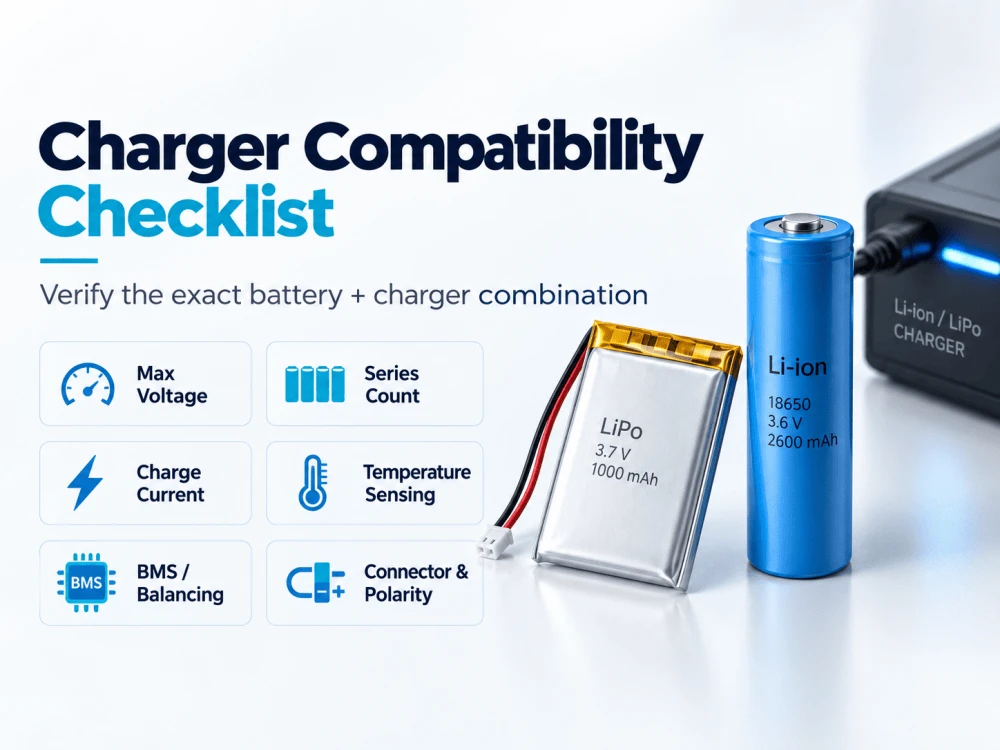
Before approving interchangeability, verify the following:
Maximum charging voltage: The charger's CV target must match the cell specification.
Series-cell count: The charger must regulate the correct total pack voltage.
Charging current: The output current must remain within the battery's approved limits.
Charge termination: The termination current, recharge threshold, and fault handling must be compatible.
Temperature sensing: The charger and pack must use compatible temperature sensors and charging thresholds.
BMS and balancing: Multi-cell packs must have an appropriate monitoring, protection, and balancing strategy.
Connector and polarity: Physical connector compatibility does not guarantee correct wiring or polarity.
Communication requirements: Smart battery packs may require specific enable signals or communication protocols before charging is permitted.
Application Example: Charger Compatibility for a 45mAh LiPo Battery in TWS Earbuds
A consumer electronics project required a compact lithium polymer battery for a pair of TWS earbuds. The battery specifications included a nominal voltage of 3.7V, a minimum capacity of 45mAh, and a maximum charging voltage of 4.20V.
The battery also required a DW01A/8205 protection circuit and a compact design within the specified dimensional limits.
► The Engineering Consideration
Although standard LiPo and Li-ion batteries commonly use CC/CV charging, selecting a compatible charger requires more than matching the 4.20V charging voltage.
For a 45mAh battery, the charging current corresponding to different C-rates would be:
|
Charge Rate |
Charging Current |
|
0.2C |
9mA |
|
0.5C |
22.5mA |
|
1C |
45mA |
These values illustrate the relationship between capacity and charging current. The actual charging limit must be confirmed against the selected cell's datasheet.
A charger designed for a larger lithium-ion battery may use a charging current that exceeds the allowable limit of a miniature LiPo cell, even when both batteries have the same 4.20V maximum charging voltage.
► Key Compatibility Checks
Before finalizing the battery and charger combination, engineers should verify:
- Maximum charging voltage and voltage accuracy
- Standard and maximum charging current
- Charge termination and recharge behavior
- Pre-charge conditions for deeply discharged cells
- Protection circuit compatibility
- Connector polarity and electrical interface
► Engineering Takeaway
For miniature LiPo batteries used in TWS earbuds, matching the nominal voltage alone is not sufficient.
Charger compatibility depends on the complete charging profile, allowable current, and battery protection design.
7. What Should Be Included in a Battery Charging RFQ?
For OEM and ODM battery projects, the RFQ should define the charging requirements clearly enough for suppliers to quote comparable solutions.
A practical battery charging RFQ should include:
Cell chemistry and model: Specify the preferred cell type or approved equivalent.
Battery configuration: Define the series/parallel arrangement and nominal pack voltage.
Maximum charge voltage: State the required voltage per cell and for the complete pack.
Charging current: Define normal and maximum current in amps and C-rate.
Charging-temperature range: Include any required low- and high-temperature charging behavior.
BMS requirements: Specify overcharge protection, temperature monitoring, and balancing where applicable.
Electrical interface: Define connector, polarity, NTC, pinout, and communication requirements.
Validation requirements: Request the charging profile, temperature-rise results, and relevant cycle-life test conditions.
These specifications help purchasing teams compare technically equivalent battery solutions and reduce charger-integration problems during production.
Conclusion
The key difference in LiPo vs Li-ion charging is not necessarily the charging method. Standard cells commonly use CC/CV charging, and many share a 4.20V-per-cell full-charge target.
What matters is whether the charger matches the exact battery specification.
For purchasing engineers and product developers, charging voltage, allowable current, temperature limits, charge termination, series-cell balancing, and BMS compatibility should all be verified before approving a battery and charger combination.
The correct approach is to qualify the complete charging system-not simply choose a charger labeled "LiPo" or "Li-ion."
FAQ
01. What is the main difference between LiPo and Li-ion charging?
02. Can I charge a LiPo battery with a Li-ion charger?
03. What is the correct LiPo charging voltage?
04. Is 1C charging safe for every LiPo battery?
05. Do multi-cell LiPo batteries need balance charging?
06. What should I check before buying a LiPo or Li-ion charger?