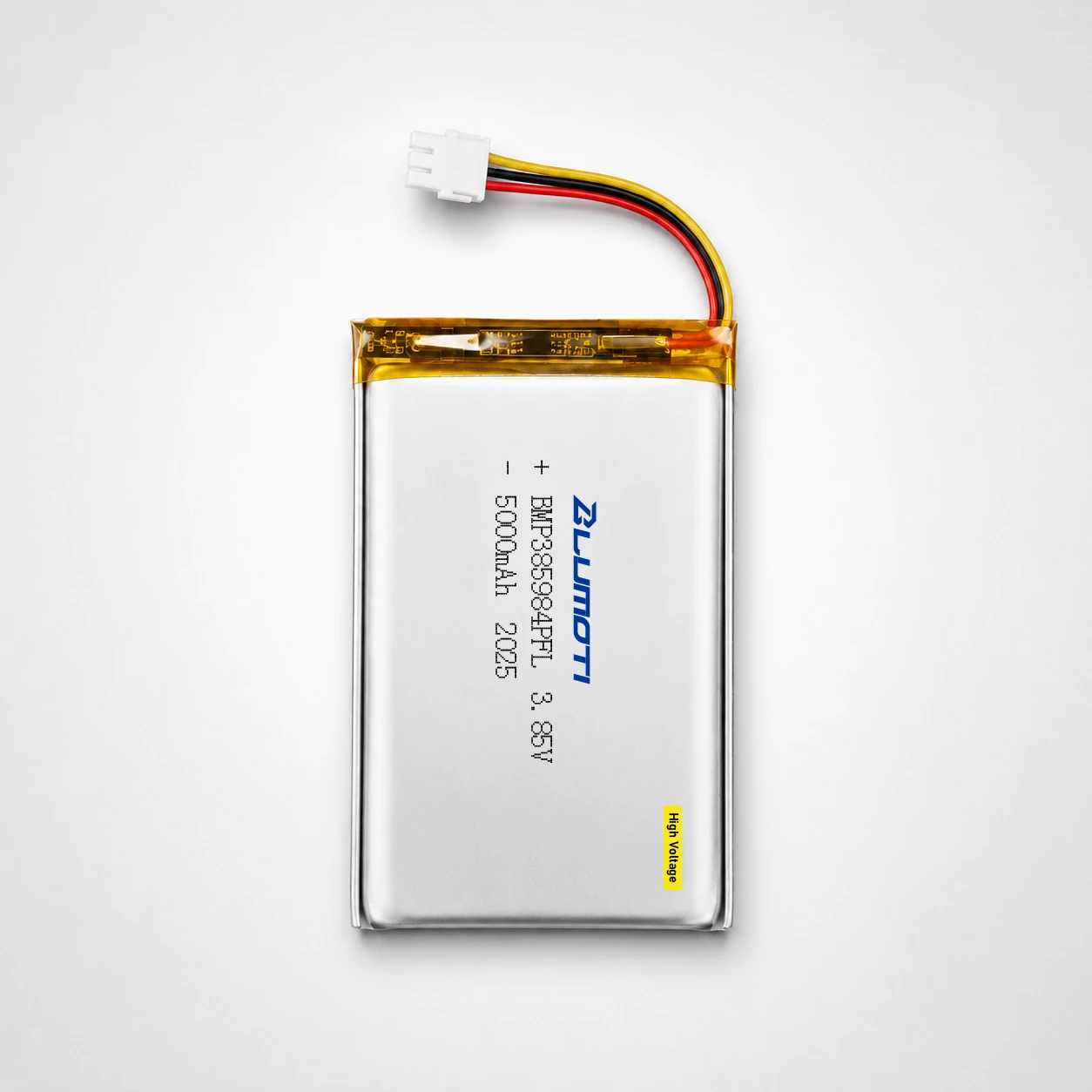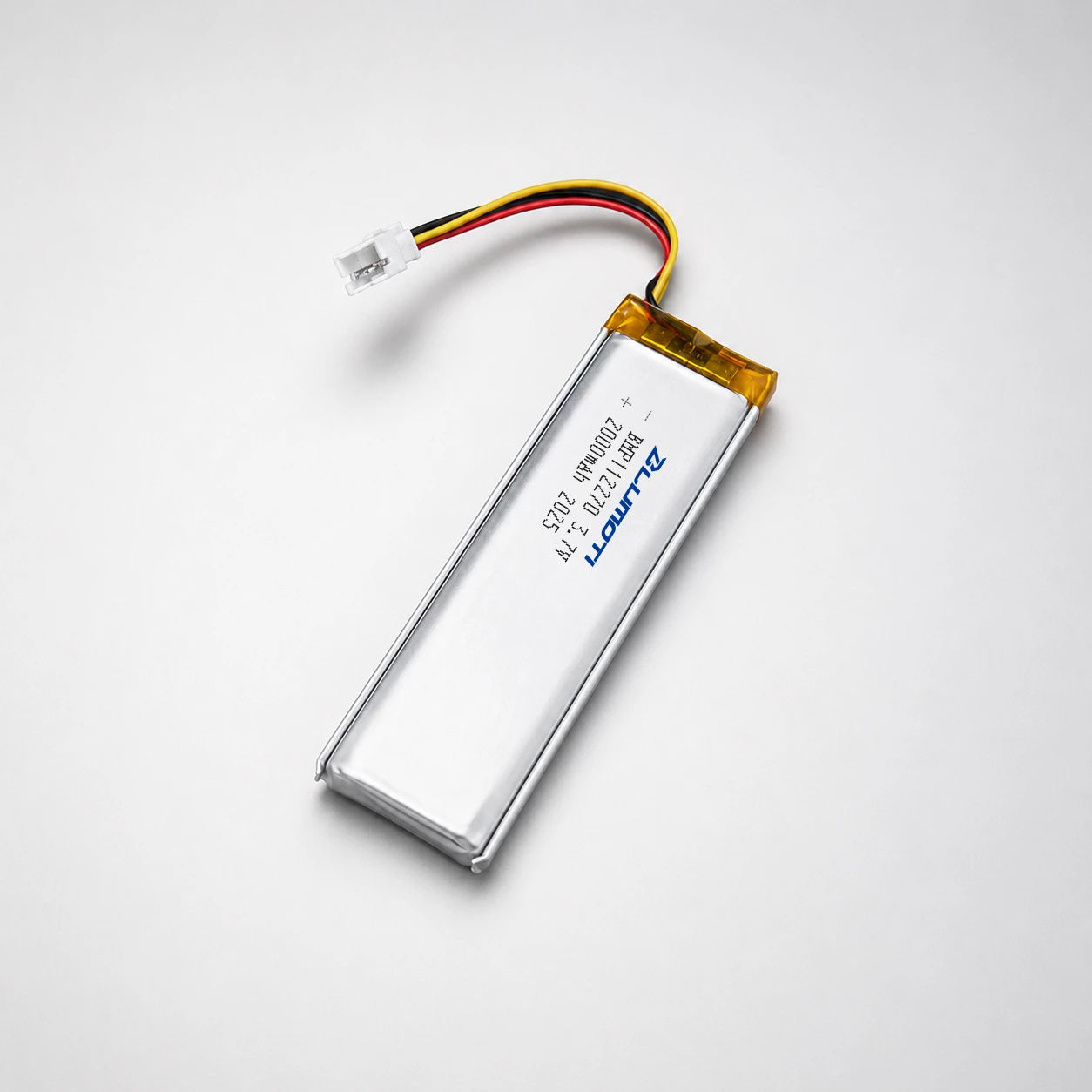

Quick Answer: Which Has a Higher Discharge Rate, LiPo or Li-ion?
High-discharge LiPo batteries are often designed for high-current applications, but high-power Li-ion cells can also deliver substantial continuous and peak current. Battery format alone doesn't determine discharge performance.
For OEM battery sourcing, compare three specifications:
C-rating:
The advertised discharge current relative to battery capacity.
Peak current:
The maximum current a battery can deliver for a specified duration.
Voltage sag:
How far battery voltage drops under the required load.
Bottom line: A high C-rating means little if the pack cannot maintain your equipment's minimum operating voltage during peak demand.
Buyers should verify continuous current, pulse duration, loaded voltage, and temperature rise under identical test conditions.
For a broader technology comparison, see Blumoti's Li Polymer Battery vs Lithium Ion Battery guide. [1]
1. LiPo vs Li-ion C-Rating: How Much Current Can the Battery Actually Deliver?
Battery discharge C-rating indicates current relative to rated capacity.
Discharge Current (A) = Capacity (Ah) × C-Rating
For a 2,200 mAh (2.2 Ah) LiPo battery advertised at 50C continuous:
2.2 Ah × 50C = 110 A
The label claims 110 A of continuous current. It doesn't prove the pack can sustain that load without excessive voltage sag, overheating, or triggering protection circuitry. [2]
► Continuous vs. Peak Discharge Current: What Should Buyers Verify?
- Continuous discharge current is the current a battery can sustain within specified electrical and thermal limits.
- Peak current (burst current) is allowed for a limited duration under defined conditions.
For example, a 100C burst rating means little without a specified pulse duration, starting state of charge (SoC), temperature, and recovery interval.
A 5-second pulse rating cannot automatically be used for a 10-second load.
Procurement check: Request continuous and peak current ratings in amperes, with supporting voltage and temperature measurements.
2. High-Discharge LiPo vs High-Power Li-ion: What Determines Current Capability?
LiPo vs Li-ion discharge performance depends primarily on electrode design, current collectors, internal resistance (IR), and thermal limits.
Purpose-built high-C-rate LiPo pouch cells may use low-resistance electrode structures and multiple current-collection tabs.
Energy-focused 18650 and 21700 Li-ion cells may prioritize capacity, but high-power cylindrical designs can support demanding discharge loads.
For example, the Molicel INR-21700-P45B specifies:
Typical capacity: 4.5 Ah
Continuous discharge current: 45 A, with an 80°C cutoff condition
Typical DC internal resistance: 15 mΩ at 50% SoC
These are manufacturer-published cell specifications, not finished-pack performance guarantees. The stated thermal cutoff does not establish an acceptable operating temperature for every application. [3]
LiPo vs Li-ion Discharge Performance: What Should Suppliers Prove?
|
Metric |
High-Discharge LiPo Pouch |
High-Power Cylindrical Li-ion |
|
Continuous current |
Verify cell and pack amperage |
Verify exact cell model and pack configuration |
|
Peak current |
Confirm burst duration and recovery |
Confirm pulse rating and recovery |
|
Internal resistance |
Measure cell and pack DC resistance |
Measure cell and pack DC resistance |
|
Voltage sag |
Test at the required load |
Test at the same load |
|
Thermal limits |
Verify temperature under discharge |
Verify temperature under discharge |
Neither configuration automatically wins.
Procurement check: Compare finished packs at the same nominal voltage, current profile, SoC, and temperature. Don't compare one supplier's pack-level rating with another supplier's cell-level specification.
3. Peak Current: How Long Must a Battery Sustain the Load?
A supplier may advertise 150 A peak discharge current, but that number is incomplete without the pulse conditions.
For procurement, peak current capability must include:
- Pulse duration: How many seconds must the pack sustain the specified current?
- Repetition: How frequently will that peak occur?
- Starting SoC: Does the battery still meet requirements near the end of its usable charge?
- Temperature: Can the pack deliver the pulse at the equipment's minimum operating temperature?
- Voltage limit: Will the loaded voltage remain above the equipment's minimum input requirement?
► Example: How to Specify a Peak-Current Acceptance Test
Consider a hypothetical OEM device using a 4S lithium battery pack.
Its proposed load requirements are:
|
Test Parameter |
Example Requirement |
|
Continuous operating current |
10 A |
|
Peak discharge current |
30 A |
|
Peak duration |
5 seconds |
|
Pulse repetition |
3 pulses, separated by 30 seconds at 10 A |
|
Starting SoC |
20% |
|
Ambient temperature |
25°C |
|
Minimum loaded pack voltage |
13.0 V |
|
Protection response |
No unexpected BMS cutoff |
These values are illustrative RFQ requirements, not universal lithium-battery operating limits. The cell manufacturer must also permit the specified currents, voltages, and temperatures.
Acceptance criterion: The proposed pack must complete the defined pulse sequence without dropping below 13.0 V, triggering protection, or exceeding agreed thermal limits.
A battery that delivers 30 A for one second but fails during the fifth second does not meet this specification.
Procurement check: Require measured current, voltage, and temperature traces for the complete pulse sequence-not a single peak-current number.

4. LiPo vs Li-ion Voltage Sag: How Do You Determine Pass or Fail?
Voltage sag is the drop in terminal voltage when a battery supplies current.
Its resistive component can be estimated using:
Voltage Sag (V) ≈ Load Current (A) × Effective DC Resistance (Ω)
This is a first-order calculation. Actual loaded voltage also depends on electrochemical polarization, SoC, temperature, and pulse duration. [4]
► Voltage Sag Calculation: Two Battery Packs Under the Same Load
Assume two hypothetical 4S battery proposals are evaluated at the same SoC and temperature.
Both begin with a rested pack voltage of 14.0 V.
The equipment requires at least 13.0 V under a 30 A load.
|
Parameter |
Pack A |
Pack B |
|
Rested voltage |
14.0 V |
14.0 V |
|
Load current |
30 A |
30 A |
|
Effective pack resistance |
20 mΩ |
60 mΩ |
|
Calculated voltage sag |
0.6 V |
1.8 V |
|
Estimated loaded voltage |
13.4 V |
12.2 V |
|
Estimated resistive heat loss |
18 W |
54 W |
|
13.0 V voltage criterion |
PASS |
FAIL |
Calculations:
Pack A: 30 A × 0.020 Ω = 0.6 V
Estimated loaded voltage = 14.0 − 0.6 = 13.4 V
Pack B: 30 A × 0.060 Ω = 1.8 V
Estimated loaded voltage = 14.0 − 1.8 = 12.2 V
Pack A meets the voltage requirement in this simplified model. Pack B does not.
Resistive heat loss is estimated using:
P = I² × R
At 30 A, Pack B's estimated resistive loss is three times Pack A's.
These are modeled values, not actual discharge-test results. The effective resistance figures are assumed to represent the specified pulse conditions. Pack A's calculated voltage pass does not establish full test compliance; pulse repetition, polarization, temperature, and protection behavior must also pass.
► Why Does Voltage Sag Matter for Battery Procurement?
Excessive battery voltage sag under load may cause:
- Premature low-voltage cutoff (LVC).
- Reduced motor output or unstable equipment operation.
- Unexpected BMS shutdown during current peaks.
Procurement check: Define the minimum loaded voltage first. Then require suppliers to prove that the complete pack stays above it throughout the specified load profile.

5. Why Does Voltage Sag Change With SoC, Temperature, and Pack Design?
A battery that passes a peak-current test at full charge may fail the same test near the end of discharge.
► State of Charge: Why Can Voltage Sag Trigger Early Cutoff?
At lower SoC, the battery's available voltage decreases, and polarization may become more pronounced.
A current pulse that passes at 80% SoC may trigger low-voltage protection at 20% SoC.
Test at the lowest SoC your product is expected to use.
► Low Temperature: How Does Cold Affect Discharge Current?
Low temperatures generally increase effective resistance and reduce high-current performance. The impact depends on cell chemistry, battery design, and operating conditions. [4]
Request low-temperature discharge curves at your specified minimum ambient temperature rather than assuming a fixed resistance increase.
► Pack Resistance: Why Does Cell-Level IR Not Tell the Whole Story?
Connectors, busbars, welds, cables, and BMS components contribute to total pack resistance.
A low-resistance cell can still produce excessive voltage sag when assembled with undersized interconnects.
Procurement check: Measure DC internal resistance and loaded voltage at the finished pack terminals, using the same SoC, temperature, pulse duration, and measurement method.
Do not directly compare AC impedance and DC resistance values as if they were interchangeable. [4]
6. What Discharge Test Data Should Buyers Request Before Supplier Approval?
For a custom high-discharge LiPo battery or high-drain Li-ion battery pack, turn the required operating profile into measurable RFQ acceptance criteria.
OEM Battery Discharge Performance: RFQ Verification Table
|
RFQ Requirement |
Required Supplier Evidence |
|
Continuous discharge current (A) |
Sustained-load test with temperature measurements |
|
Peak discharge current (A) |
Recorded pulse duration and repetition results |
|
Minimum loaded voltage (V) |
Voltage trace at the specified current and SoC |
|
DC internal resistance (mΩ) |
Measurement conditions and finished-pack result |
|
Temperature rise (°C) |
Cell and pack temperatures during discharge |
|
BMS protection limits |
Verified current, voltage, and thermal protection behavior |
|
Production consistency |
Agreed acceptance limits and sample test records |
All tests should use the specified battery configuration, operating temperature, and load profile. Sampling plans and acceptance thresholds should be agreed upon before production qualification.
Supplier approval should depend on verified discharge performance-not the highest advertised C-rating.
Frequently Asked Questions: LiPo vs Li-ion Discharge Rate
1. How Do You Calculate LiPo Peak Current From C-Rating?
Multiply battery capacity in ampere-hours by the advertised burst C-rating.
Peak Current (A) = Capacity (Ah) × Burst C-Rating
For a 2,200 mAh LiPo pack rated at 100C burst:
2.2 Ah × 100C = 220 A
This is the claimed peak-current rating. Actual capability must be verified at the supplier's specified pulse duration and operating conditions.
2. How Long Can a 100C LiPo Battery Sustain Peak Discharge?
There is no universal duration for a 100C burst rating.
The allowable duration depends on the specific cell design, starting temperature, SoC, voltage limits, and recovery interval.
Request the manufacturer's burst-current test conditions before approving the rating.
3. Can High-Drain 21700 Li-ion Cells Replace High-C-Rate LiPo Packs?
Yes, provided the proposed 21700 Li-ion battery pack meets the same continuous current, peak-current duration, minimum loaded voltage, and thermal requirements.
Evaluate the finished pack configuration rather than comparing individual cell specifications with complete LiPo packs.
4. Why Can a Battery With Low Internal Resistance Still Experience Voltage Sag?
Cell internal resistance is only part of the total electrical path.
Welds, connectors, cables, BMS components, and electrochemical polarization also affect loaded voltage.
Measure voltage at the complete pack's output terminals under actual operating conditions. [4]
5. Is LiPo Battery Voltage Sag Permanent or Reversible?
Normal voltage sag is largely reversible. Terminal voltage typically recovers after the load decreases.
However, voltage recovery does not prove the battery was operated safely. Excessive current, overheating, or operation outside the manufacturer's limits can cause irreversible degradation.
Conclusion: Verify Peak Current and Voltage Sag Before Buying
LiPo vs Li-ion discharge rate should be evaluated through actual current delivery-not C-rating alone.
For OEM sourcing, verify continuous discharge current, peak-current duration, voltage sag, DC internal resistance, and temperature rise under the intended operating conditions.
Blumoti Battery supports custom high-discharge LiPo batteries and lithium-ion battery pack development for OEM/ODM applications.
Send your continuous current, peak-load profile, minimum operating voltage, and temperature requirements to evaluate a battery solution against measurable performance criteria.
Technical References
[1] Blumoti Battery. Li Polymer Battery vs Lithium Ion Battery – Which Is Best for Your Application? General comparison of battery construction, discharge performance, and selection.
https://www.blumoti-battery.com/info/li-polymer-battery-vs-lithium-ion-battery-wh-103613377.html
[2] Blumoti Battery. 3S LiPo Battery Guide: Voltage, C-Rating, Charging, Storage, and Safety. Discharge C-rating and current calculations.
https://www.blumoti-battery.com/info/3s-lipo-battery-guide-voltage-c-rating-char-103608044.html
[3] Molicel. INR-21700-P45B Product Data Sheet, Version 1.4. Cell capacity, continuous discharge current, and DC resistance specifications.
[4] Battery University. BU-902: How to Measure Internal Resistance. DC load testing, AC impedance, and resistance measurement considerations.
https://batteryuniversity.com/learn/article/how_to_measure_internal_resistance
Technical note: Worked examples and proposed RFQ conditions are illustrative. Final acceptance limits must follow the selected cell manufacturer's specifications and the equipment's validated operating requirements.