

Hey there, fellow FPV drone enthusiasts! I'm an FPV drone battery supplier, and today I'm stoked to talk about one of the most crucial aspects of drone batteries: the discharge rate.
Let's start with the basics. So, what exactly is the discharge rate of an FPV drone battery? In simple terms, the discharge rate tells you how quickly a battery can release its stored energy. It's usually expressed as a multiple of the battery's capacity, which is measured in ampere - hours (Ah).
For example, if you have a 2Ah battery with a 10C discharge rate, the "C" stands for the battery's capacity. So, this battery can discharge at a rate of 10 times its capacity. In this case, 10C of a 2Ah battery means it can discharge at a rate of 10 * 2A = 20A.
Now, why is the discharge rate so important for FPV drones? Well, FPV drones are all about speed, agility, and quick maneuvers. When you're flying an FPV drone, you need a battery that can supply a large amount of current instantly to power the motors during high - power situations like acceleration, sudden climbs, or sharp turns. A battery with a low discharge rate might not be able to keep up with the power demands of your drone, leading to poor performance, lower speed, and even motor stalls.
Let's take a look at some common discharge rates. You'll often see discharge rates like 20C, 30C, 40C, and even higher in FPV drone batteries. The higher the C - rating, the faster the battery can discharge its energy.
If you're into more casual FPV flying, a 20C or 30C battery might be sufficient. These batteries can handle the everyday power requirements of your drone, allowing for smooth flight. But if you're a hardcore racer or someone who likes to do crazy acrobatic maneuvers, you're going to need a battery with a much higher discharge rate, like a 40C or 50C battery.
Factors Affecting Discharge Rate
Several factors can affect the discharge rate of an FPV drone battery. One of the main factors is the internal resistance of the battery. A battery with lower internal resistance can discharge energy more efficiently. As the battery ages or if it's been over - charged or over - discharged in the past, its internal resistance can increase, which will lower its effective discharge rate.
Another factor is the temperature. Batteries work best within a certain temperature range. If it's too cold, the chemical reactions inside the battery slow down, reducing the discharge rate. On the other hand, if it's too hot, the battery can overheat, which can also damage it and lower its performance.
So, when you're choosing an FPV drone battery, you need to consider the discharge rate in relation to your flying style. If you're just starting out, you might not need the highest - rated battery on the market. But as you get more experienced and start pushing the limits of your drone, upgrading to a battery with a higher discharge rate can make a huge difference.


Here at our supply, we offer a wide range of FPV drone batteries with different discharge rates to suit your needs. We have the 4s Drone Battery, which is a popular choice for many FPV pilots. The 4S configuration provides a good balance of voltage and power, and we offer different discharge rates for this battery.
The Drone Battery 11.1 V is also a great option. This voltage is commonly used in FPV drones, and our batteries come with various discharge rates to ensure you get the performance you need.
If you're looking for more power, we have the 6s Drone Battery. The 6S setup provides a higher voltage, which means more power for your drone. And of course, we offer different C - ratings for these batteries as well.
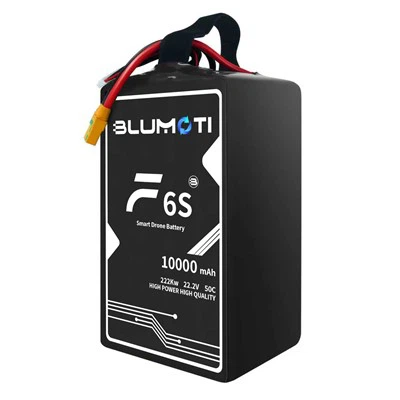
For those who need a large - capacity battery, our Drone Battery 10000mAh is a top - notch choice. It can store a significant amount of energy, and with the right discharge rate, it can keep your drone flying for longer and performing at its best.
And let's not forget about our 6s 22000mAh Lipo Battery. This high - capacity, high - voltage battery is designed for serious FPV enthusiasts who want the ultimate power and flight time.
Now, let's talk a bit about how to calculate the actual current a battery can supply based on its discharge rate. As I mentioned earlier, you just multiply the C - rating by the battery's capacity in ampere - hours. But keep in mind that this is the maximum current the battery can provide under ideal conditions. In real - world scenarios, there are always some losses due to the internal resistance of the battery and the wiring in your drone.
When you're out flying your FPV drone, the power consumption of your motors will vary depending on your flying style. If you're hovering gently, the motors don't need as much power, but if you're doing high - speed dives or steep climbs, the power demand can shoot up quickly. That's why a battery with a high discharge rate is essential for those high - power situations.
One more thing to note is that you should always match the battery's discharge rate to the power requirements of your drone's motors. If you use a battery with a discharge rate that's too low, you won't be able to get the full performance out of your drone's motors. On the other hand, using a battery with an extremely high discharge rate when your motors don't need that much power can be a waste of money.
So, if you're in the market for a new FPV drone battery, we're here to help. We've got a team of experts who can assist you in choosing the right battery based on your flying style, your drone's specifications, and your budget. Whether you're a beginner looking for an affordable and reliable battery or a pro racer in need of the highest - performance battery on the market, we've got you covered.
If you're interested in discussing your battery needs further or want to place an order, don't hesitate to reach out. We're always happy to have a chat and help you find the perfect FPV drone battery for your setup.
References
- Battery Technology Handbook for Drones
- FPV Drone Flying Guides